Coming soon…
Coming soon…
Though Colombia had not reached the finals of the World Cup since 1998, the team arrived at Brazil 2014 as many people’s dark horses. The reason was that over the last two or three years Los Cafeteros had produced a crop of exceptionally talented players that had begun to make names for themselves across Europe. The first of these was Radamel Falcao, who after enjoying Europa League success at Porto had joined Atlético Madrid in 2011, now coached by Diego Simeone, who had worked with the striker as a youngster at River Plate. Falcao won a second successive Europa League title in 2012 but left the club the following summer to join Monaco, where a knee injury in a Coupe de France game threatened to keep him out of the World Cup.
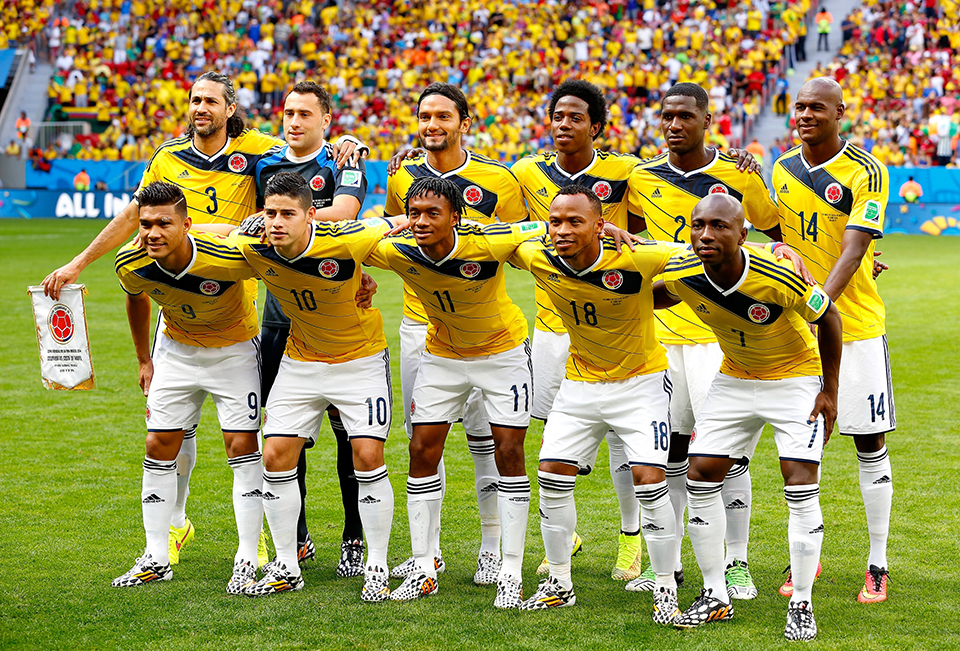
While neither Jackson Martinez nor Teófilo “Teo” Gutiérrez would quite fill the void left in the absence of Colombia’s star striker, both could be a handful for defences. But it wasn’t just up front where Colombia looked strong. Tricky winger Juan Pablo Cuadrado’s career had taken him to opposite ends of Italy, first at Udinese and then Lecce, before settling in Florence, where he’d become a key member of Vincenzo Montella’s exciting Fiorentina side. Even the defensive players, Zapata, Zuniga and captain Yepes, had several years experience playing for top clubs in Serie A.
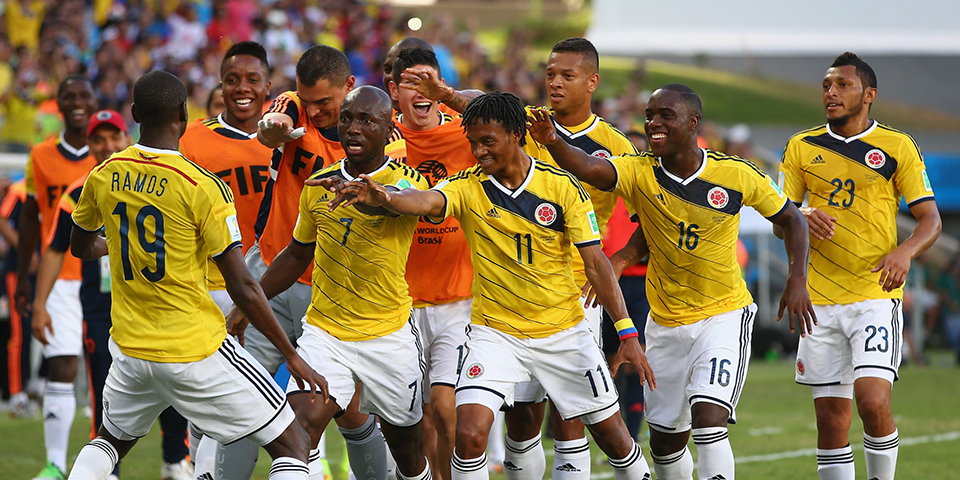
Colombia’s most promising talent was their young number ten, James Rodriguez. The midfielder had also joined Porto as a teenager, before following Falcao to Monaco. At twenty-two, Rodriguez was already considered one of South American football’s top prospects, having been nominated as the successor to Colombian legend Carlos Valderrama — by none other than Valderrama himself.
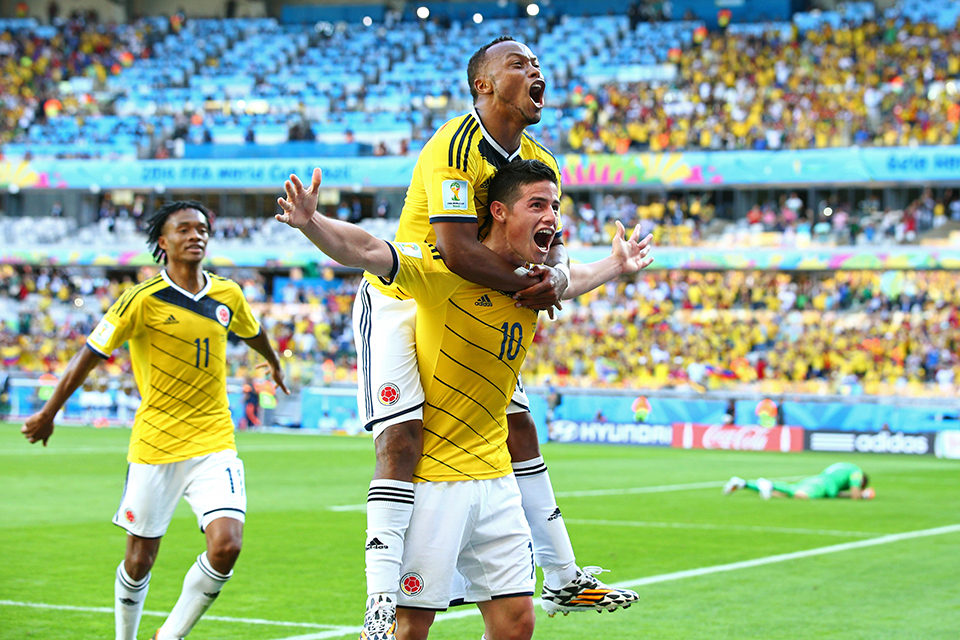
The man handed the task of harnessing all this creative talent was the Argentina José Pekerman, who’d led his own country to the quarter-finals of the World Cup in 2006. Colombia had finished behind Argentina in qualifiying, yet found themselves among the eight seeded teams for the World Cup draw. Consequently, they were joined in their first round group by Greece, Ivory Coast and Japan. On paper it looked a relatively easy proposition, but fans were wary of suffering a repeat of 1994, when Colombia had been tipped by Pelé to win the competition, only to lose their first two games and suffer a humiliating (and ultimately tragic) exit.
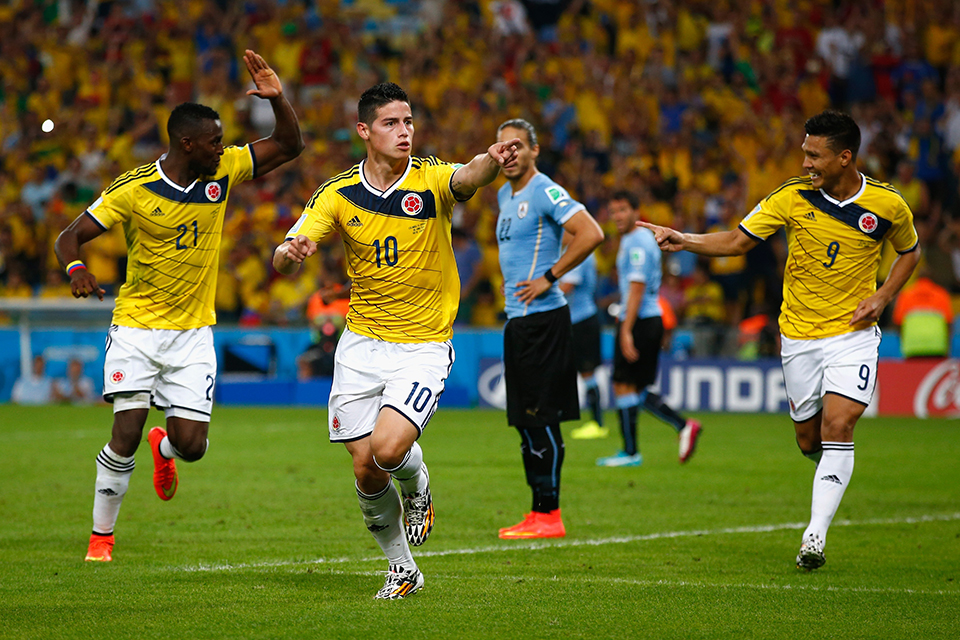
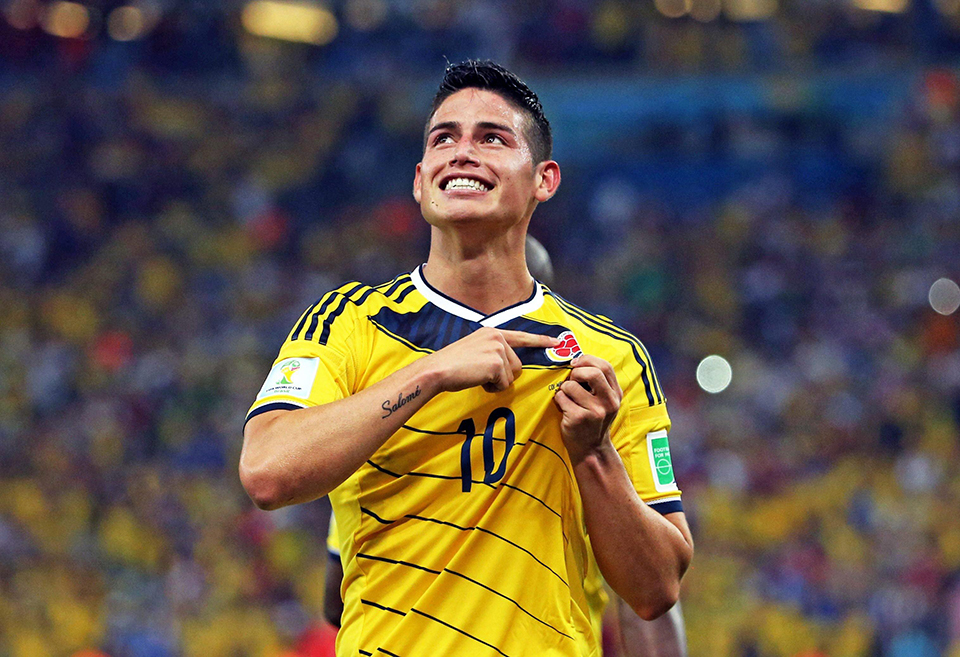
Fortunately, 2014 would prove a far more joyous tournament. Colombia won all three of their group games, scoring nine goals in the process and impressed audiences with their skillful attack-minded football, not to mention carefree celebrations. James Rodriguez lived up to his potential early on, finding the net in every match, but truly fulfilled his promise in the second round against Uruguay. At Rio’s Maracana, this all-South American clash was Colombia’s sternest test yet, but Rodriguez had found his form at just the right time. For his first goal, he controlled the ball with his chest before volleying into the top corner from outside the box. It was undoubtedly one of the goals of the tournament, and recalled that of another Rodriguez — Maxi — for Pekerman’s Argentina against Mexico in 2006.

In the second half Rodriguez doubled his side’s lead with a tapped in finish from close range. Neutral followers were delighted to see Colombia progress at the expense of Uruguay, who’d won few friends for their performances or behaviour in Brazil. Now Rodriguez and Co. faced the hosts in Fortaleza, who themselves could be considered fortunate to have got through their second round tie with Chile. For the first time, Colombia were forced to wear their red and navy away strip, a change with which their entertaining World Cup run came to an end. Two goals by central defenders (Thiago Silva and David Luiz) settled the contest, but Rodriguez still found time to get his sixth goal of the tournament from the penalty spot, thus maintaining his record of scoring in every game and ultimately earning him the Golden Boot. Though the match was overshadowed by Zuniga’s foul on Neymar which ended the youngster’s World Cup, at full-time Rodriguez was consoled by his opponents and applauded for his fine performances in Brazil.
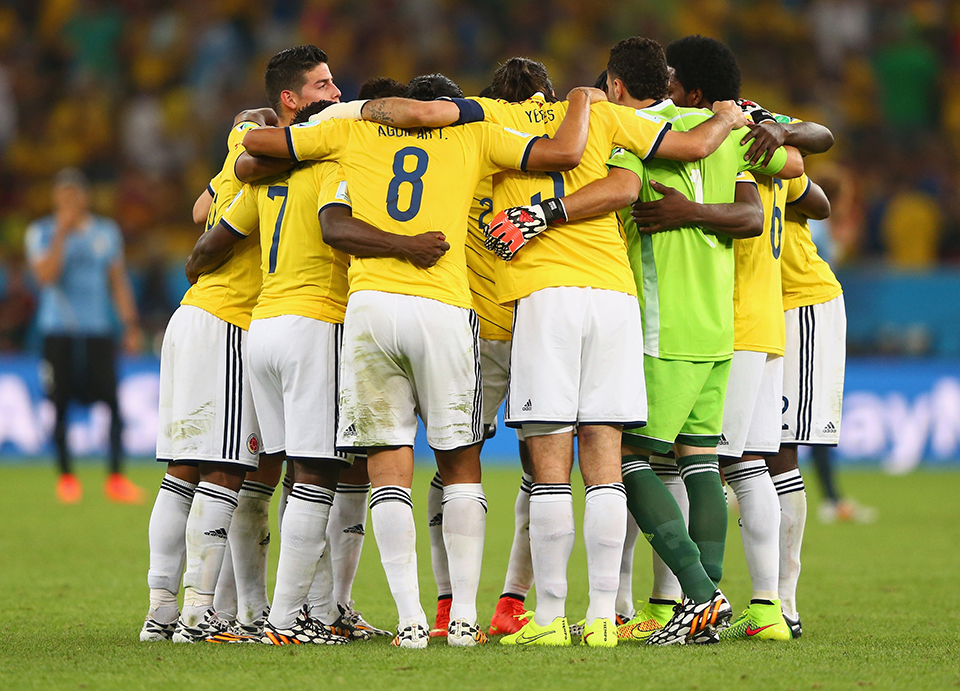
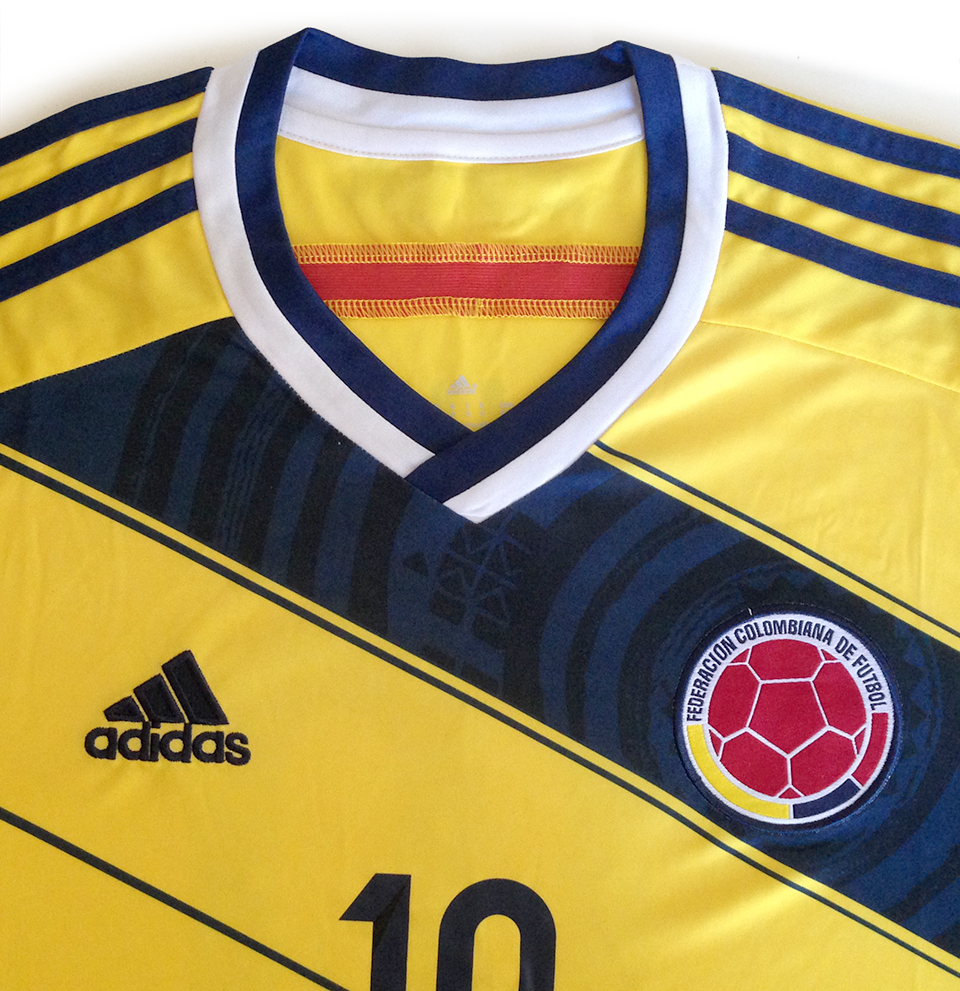
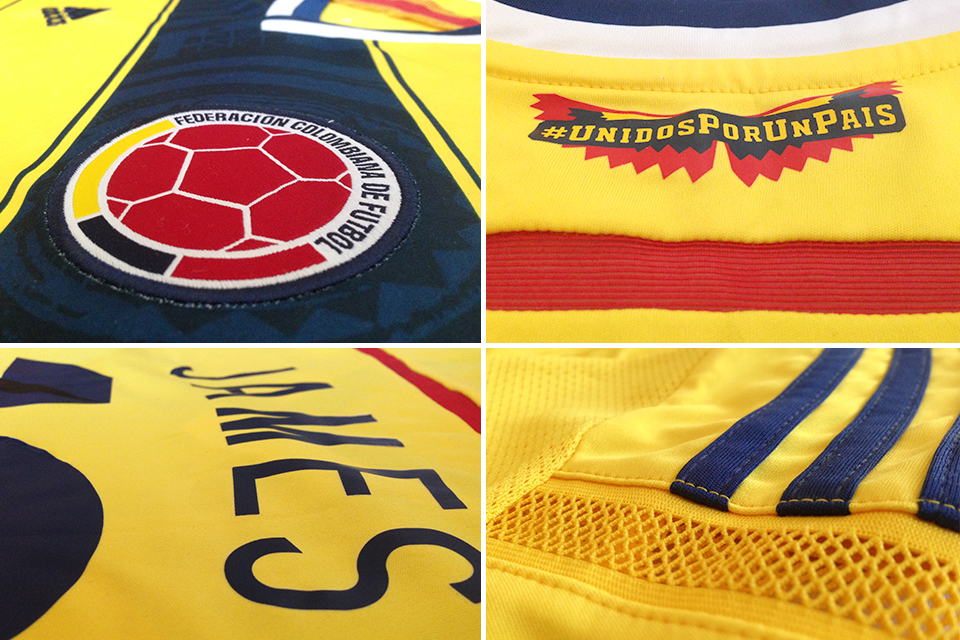
Colombia’s wholly enjoyable displays in Brazil coincided with an unprecedented new kit. Unlike most national teams, Colombia have changed their home colours with unusual frequency. Between the 1930s and 1980s the team sported sky blue, white, navy, orange and red shirts before finally settling on the current yellow in the early 1990s. In 2014 adidas unveiled a new shirt with a navy diagonal sash, into whose design was incorporated a sombrero vueltiao, the traditional hat of Colombia and one of the symbols of the country. The new kit also saw the abandonment of the traditional tricolore strip, Colombia instead reverting to white shorts and socks. Oddest of all was the inclusion of a hashtag — #UnidosPorUnPais — located on the back of the shirt just below the neck. While team slogans and motifs have been incorporated surreptitously onto shirts for a few years, this was the first instance I’ve seen of social media directly infiltrating kit design. Having finally witnessed a player excel at the World Cup with my own name on his back, naturally I couldn’t resist picking up a yellow “JAMES” shirt to add to my own collection.
They say that the most important events in English history always occur in years ending in “66”. 1066: The Battle of Hastings. 1666: The Great Fire of London. 1966: England win the World Cup. For anyone who is English, or has even spent significant time in England, the year 1966 (or even the number 66 when taken out of context) is inexorably linked with the national team’s sole footballing triumph. Sadly this is an inevitable phenomenon, borne out of the disappointing truth that England has rarely come close to replicating that success in the ensuing half-century. With every failed campaign so 1966 has become deeper ingrained into the nation’s consciousness, to the extent that the cultural and psychological weight of that victory is now far greater than the sporting achievement itself.
England had snubbed the World Cup at its inception. Believing their superiority to be without question the FA deemed England’s presence at the first three tournaments unnecessary. When the team did travel to Brazil in 1950, they suffered an unthinkable defeat to the part-timers from the United States. But subsequent back-to-back hammerings at the hands of Hungary in 1953 compelled England’s footballing authorities to reassess its global standing.
Nevertheless, encouraging performances in 1958 and 1962 plus home advantage meant that expectations were high in 1966 for the host nation. It was an England side whose qualities were truly English in an old-fashioned sense: class, hard work, personality. Leicester City’s Gordon Banks was in the process of taking over the mantle of best goalkeeper from the Soviet Union’s Lev Yashin. Blond captain Bobby Moore was England’s answer to Franz Beckenbauer: an elegant, modern defender though perhaps not as versatile as his German counterpart. England’s mix of skill and doggedness was exemplified by the balding Charlton brothers, Jack and Bobby. The latter’s darting runs inside from midfield and powerful shots from distance made him virtually impossible to mark.
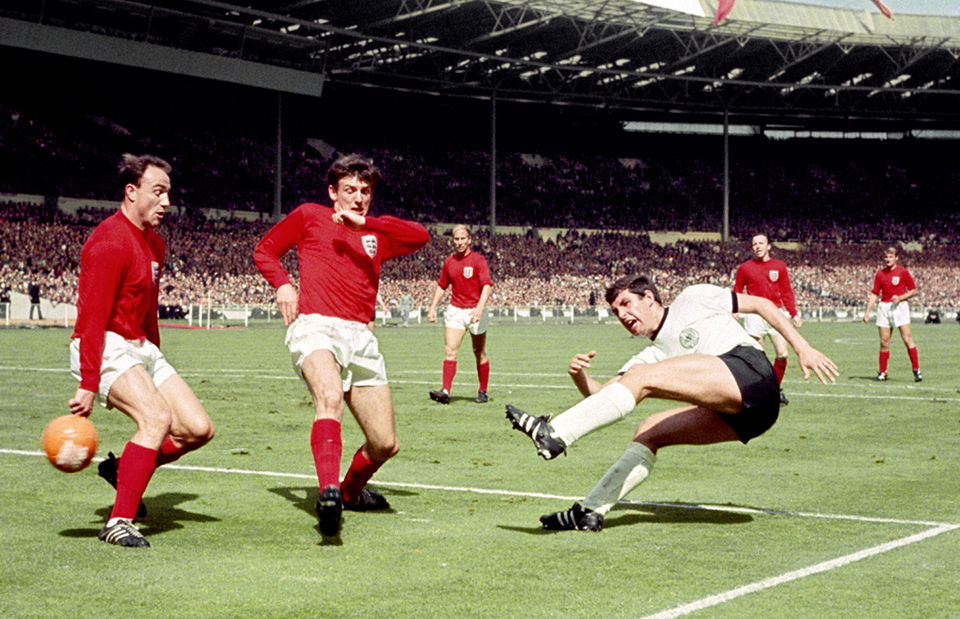
As is often the case in World Cups, fate had a strong hand in the narrative. England’s first choice centre-forward, Tottenham’s Jimmy Greaves, suffered a shin injury in the their final group match against France. His replacement, West Ham’s Geoff Hurst, scored the winner with a glancing header in the quarter-final against a cynical Argentine side (brandished “animals” by Alf Ramsey, who refused to let his players swap shirts with the South Americans). In the semi-final two timely strikes by Bobby Charlton ended the hopes of Eusebio’s Portugal. Now all that stood between England and World Cup glory was West Germany.
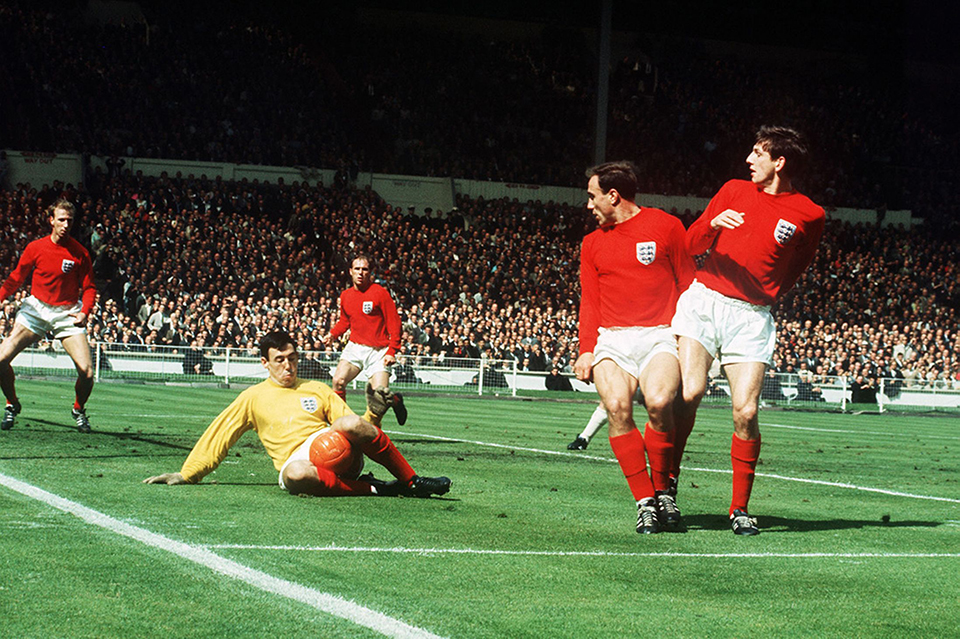
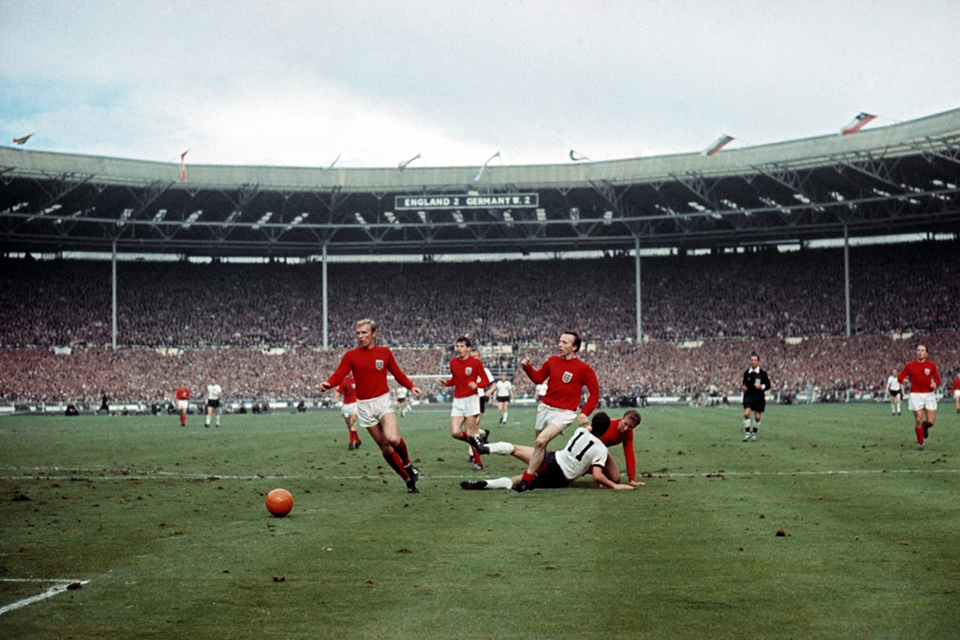
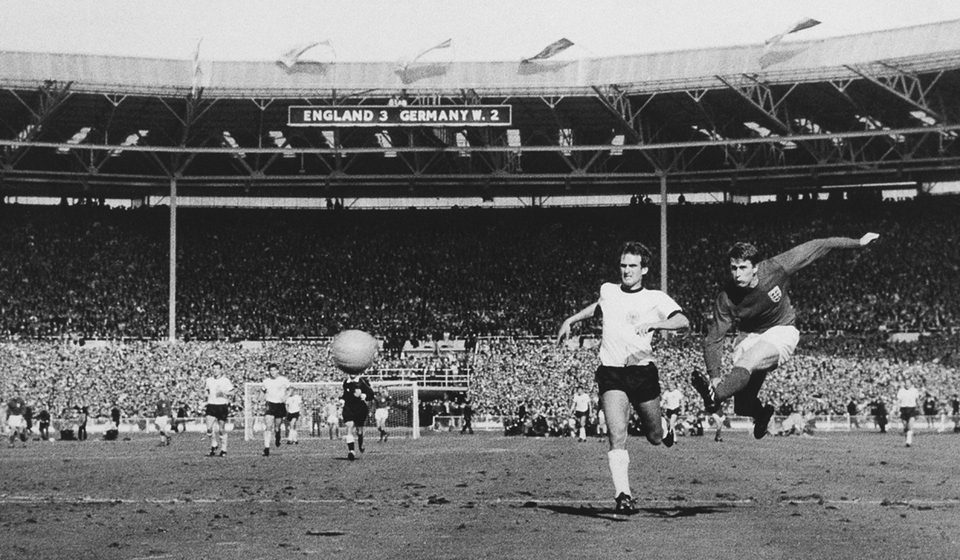
Conditions in London on July 30, 1966 were representative of the English summertime: throughout the 120 minutes the weather seemed to rotate between cloud, rain and sun at quarter-hour intervals. 98,000 spectators crammed into Wembley Stadium to see a match soaked through with drama and steeped in subtext. Hurst replied to Haller’s early strike before the third member of the West Ham trio, Martin Peters, pounced on a loose ball to put England 2-1 up. A last gasp equalizer by Weber sent the match into extra-time, during which Alan Ball’s marauding run and cross reached Hurst, whose quick turn and shot hit the crossbar and bounced on the goal-line. Anxious seconds passed before the Soviet linesman validated the goal, which to this day remains perhaps the most controversial in World Cup history. At the time replays proved inconclusive, but endless theories and analysis over the years have suggested England got lucky. To this day whenever a shot bounces on the goal-line cliché-ridden commentators are always fast to quip, “Ah, shades of ’66…” In Germany, a goal scored in this manner (bouncing on the line after hitting the bar) is commonly known as a “Wembley-Tor” (Wembley Goal).
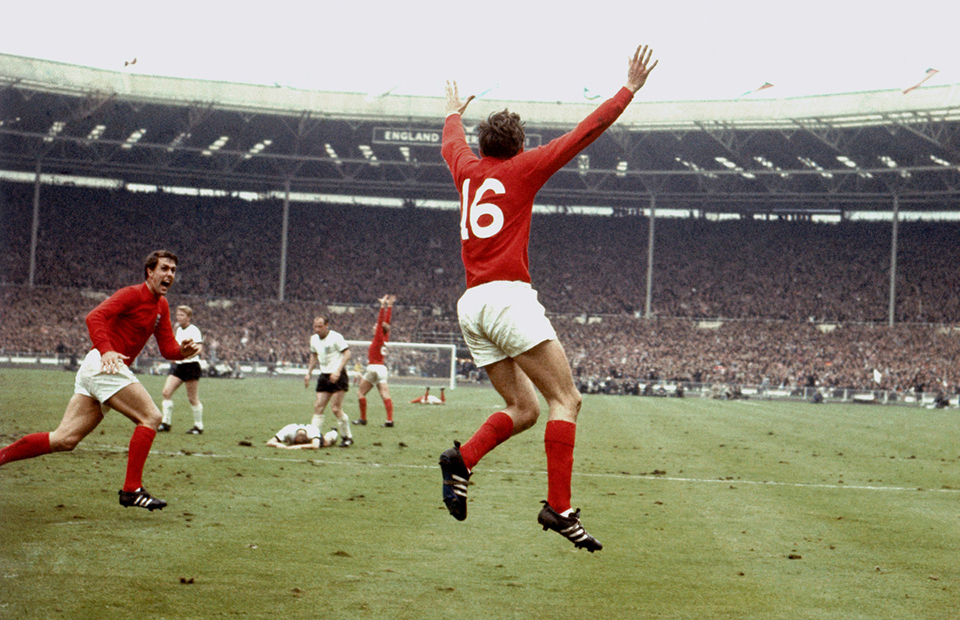
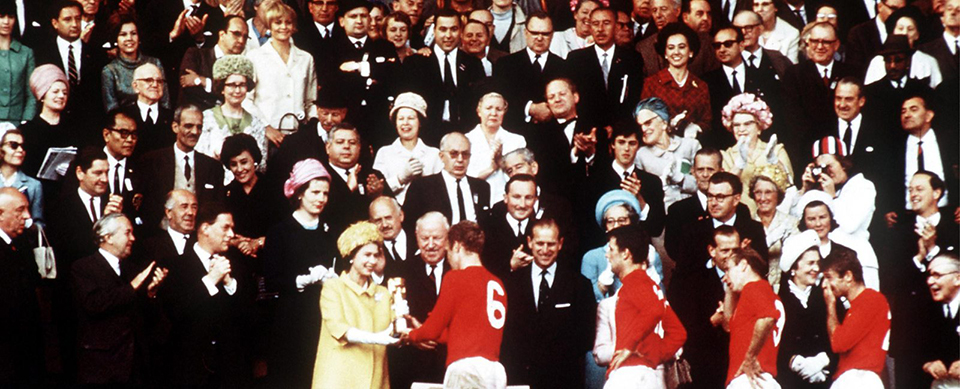
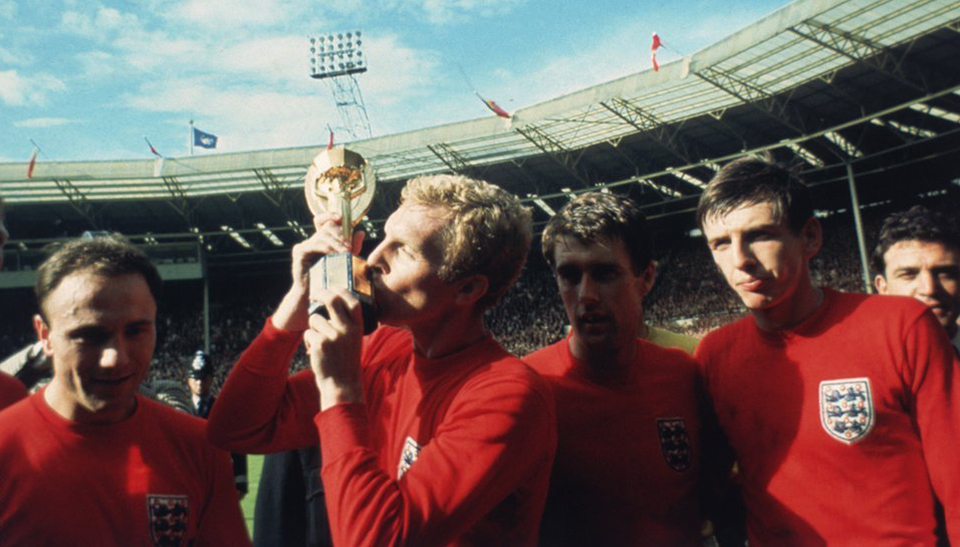
Besides Hurst’s second goal, so many aspects of the 1966 World Cup Final have become a part of English folklore, from toothless Nobby Stiles’ post-match jig around Wembley to Captain Bobby Moore wiping his muddy hands on his shirt before receiving the Jules Rimet trophy from her majesty. Perhaps most famous of all is BBC commentator Kenneth Wolstenholme’s timeless and much-imitated utterance as Hurst completed his hat-trick seconds before the final whistle: “They think it’s all over…”
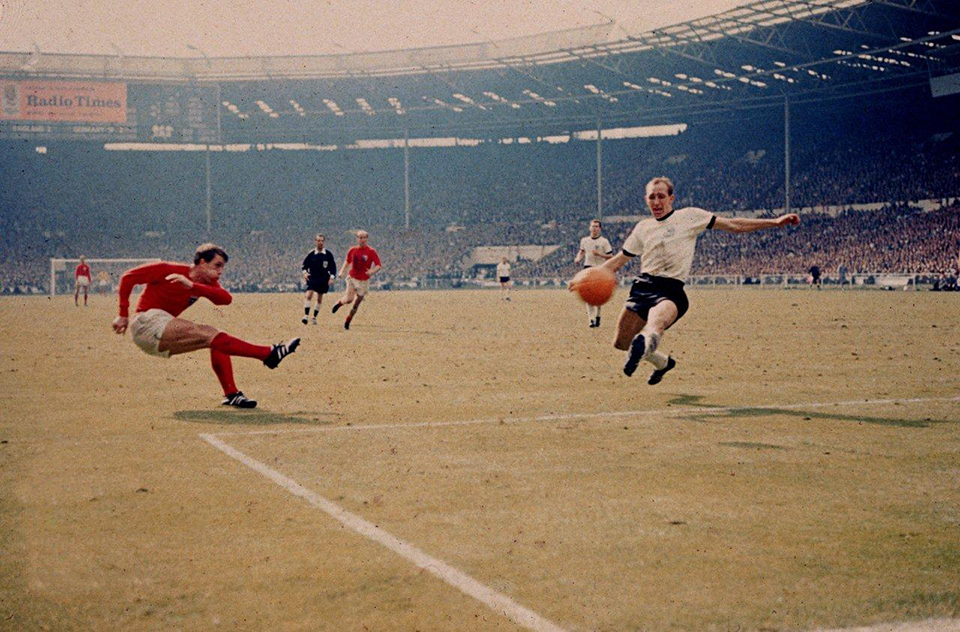
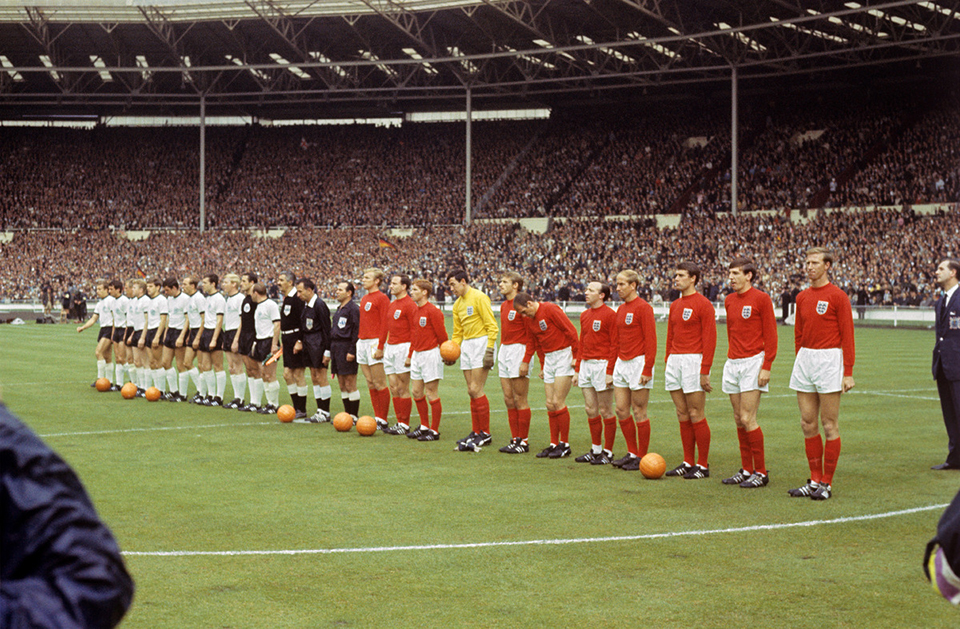
England’s victory over West Germany was made even more memorable by the fact that since both team’s first choice colours were white, the hosts donned a change strip of red shirts and white shorts. Of course, viewers at home saw the match in black-and-white, but photographs and official film of the match have immortalized the occasion in glorious Technicolor. Four years later in the heat of León, Mexico, England wore a lightweight mesh version of their red kit as they faced West Germany again in a quarter-final, though this time the strip didn’t bring the same good fortune. Yet over the years the red shirt has become equally popular with fans as the white home kit.
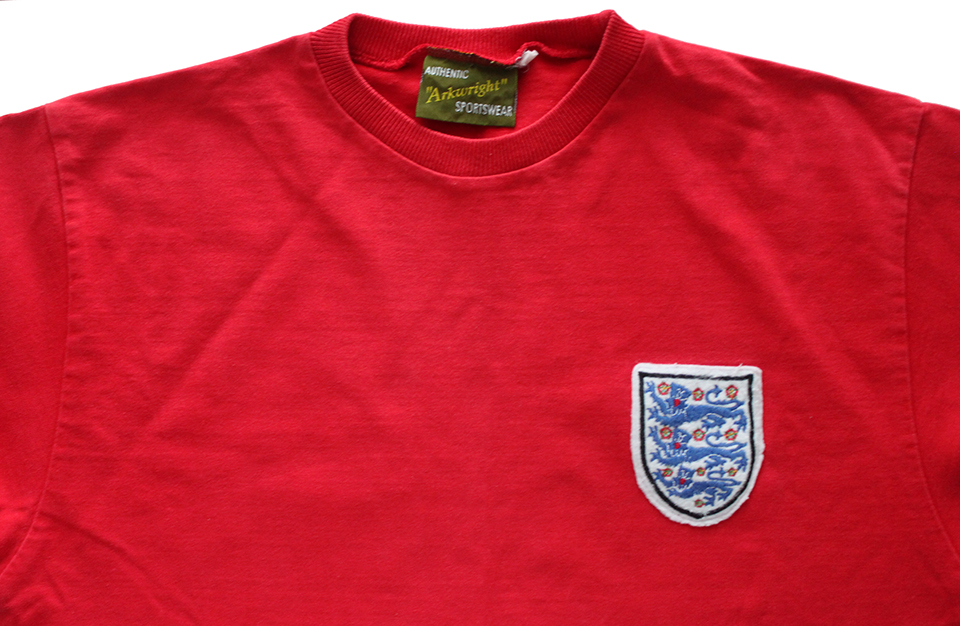
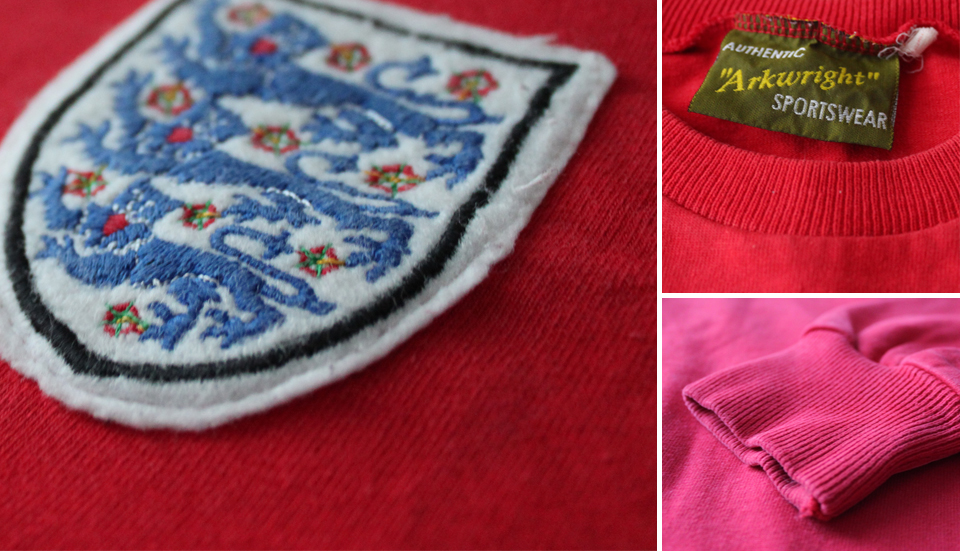
By the early 1990s football in England was undergoing a reappraisal of its history and subculture, and a rapid remarketing of the game soon followed. The shirt you see in these photographs was produced by Arkright (“The Old-Fashioned Football Company”), perhaps the first retro football shirt manufacturer of its kind. This faithful heavyweight cotton reproduction of England’s red ’66 shirt proved to be its bestseller. In 1993 I wore the shirt to a World Cup qualifier between England and Holland at Wembley. England wore their usual white and the match ended 2-2. I actually met Hurst (still the only man to score three goals in a World Cup final) at a bookstore in 2001 after I’d heard he’d be signing copies of his autobiography, 1966 And All That. He was a thoroughly nice chap, and ribbed me for not buying several copies for my whole family, adding CHEAPSKATE! to his dedication to the Taylors.
Today retro football is an industry unto itself, and old school shirts have become popular enough with fans as to directly influence modern football kit design. In 2010 England sported a ’66-style red shirt in their second round match at the World Cup in South Africa. Their opponents, yet again, were the Germans. Just before half-time, a Frank Lampard shot bounced down off the crossbar and out again. Replays showed the ball had clearly crossed the goal-line, but this time the referee disallowed the goal. After a forty-four year wait, Germany had got revenge for 1966. Proof that in football as in fashion, what goes around comes around.

If you have a spare couple of hours, check out the BBC’s full coverage of the match (complete with Kenneth Wolstenholme’s famous commentary). However, this British Pathé footage is the best I’ve ever seen of the final. Who knew they had HD in 1966?
Coming soon…
In the summer of 1990 Fiorentina entered a new era. Having just suffered their worst Serie A finish in over a decade under Italian World Cup-winner Francesco Graziani, it was then revealed that Roberto Baggio would be sold to Juventus for a world record 25 billion lire. The transfer of la Viola‘s star player to its bitterest rivals provoked violent protests on the streets of Florence, coming just two days after Juventus had beaten Fiorentina in the UEFA Cup Final. Even Fiorentina’s headquarters in Piazza Savonarola came under attack, duly prompting the club’s owners, the Pontello family, to hand over operations to film producer Mario Cecchi Gori.
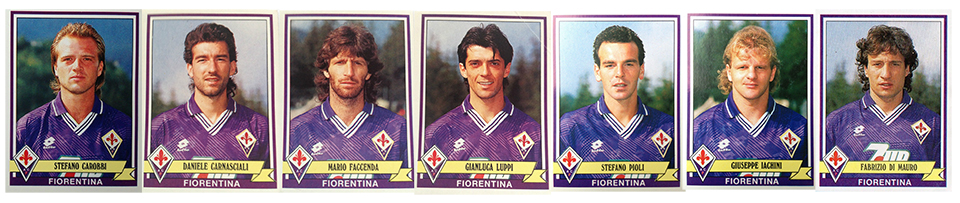
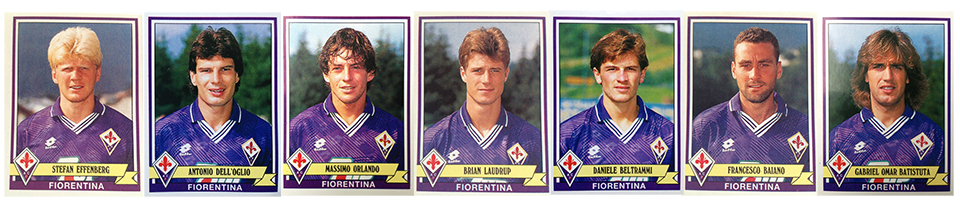
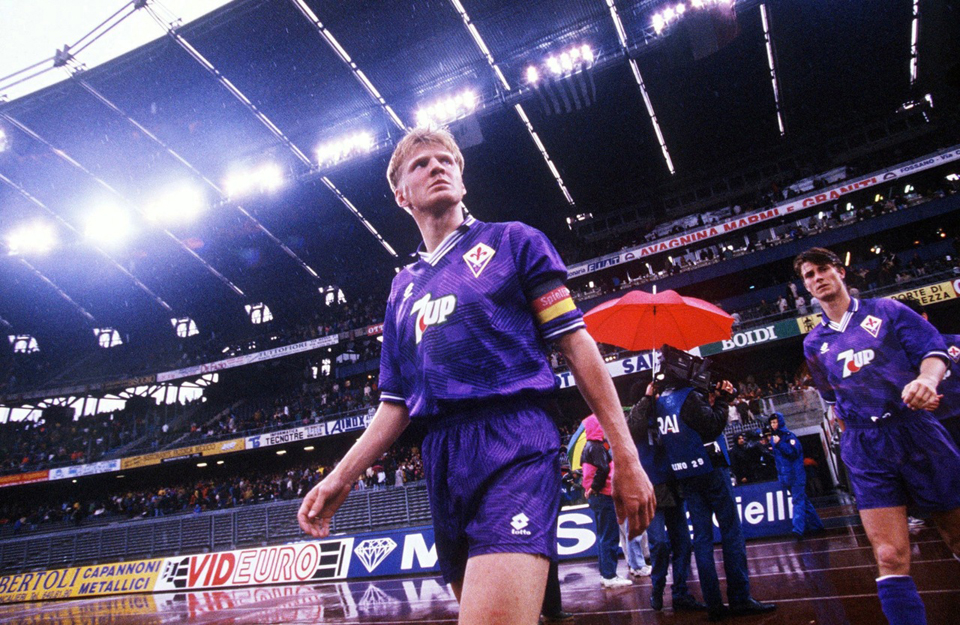
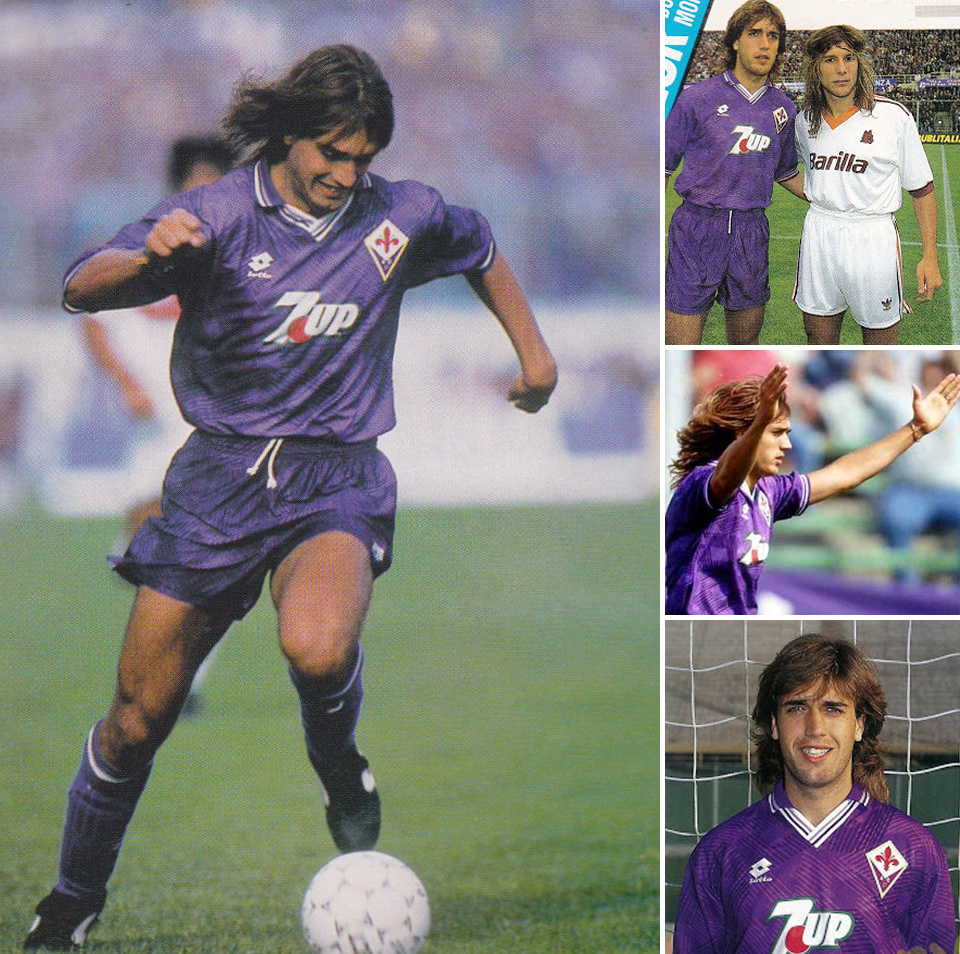
The team failed to improve in its first season without Baggio, for which Cecchi Gori immediately attempted to make amends. In what was undoubtedly the most significant business deal of his presidency, Cecchi Gori signed young Argentine forward Gabriel Batistuta. The dashing striker had just helped lead his country to victory in the Copa America in Chile, after having scored thirteen goals for Boca Juniors the previous season. He continued this impressive scoring rate in Italy, finding the net thirteen times in his debut season in Serie A. But despite Batistuta’s goals Fiorentina still failed to challenge the league leaders, finishing a mediocre twelfth for a third successive campaign. In the summer of 1992 it was hoped that the arrival of blond German midfielder Stefan Effenberg and elegant Danish winger Brian Laudrup — the latter a freshly-crowned European Champion — would make the difference.
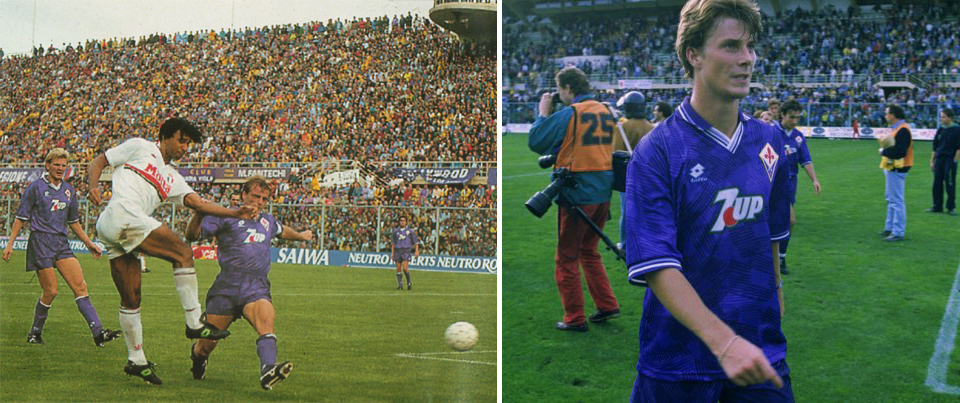
Luigi Radice, who’d coached Fiorentina to sixth place in 1974, was again at the helm, having replaced Brazilian Sebastiano Lazaroni early in the 1991-92 season. His team started slowly, drawing three of its first four games. Although goals were easy to come by — Fiorentina put seven past a hapless Ancona in week three — keeping them out at the other end proved more difficult, and after five games they’d already conceded thirteen goals, seven of which came at home against a ruthless Milan side. The team from Florence responded well to this setback but impressive victories against Sampdoria, Roma and even Juventus were countered by defeats to Cagliari, Napoli and Atalanta. This loss at home to the side from Bergamo proved Radice’s last in charge, and he was replaced by another former Viola coach, Aldo Agroppi.
At the time of Radice’s sacking Fiorentina were in a respectable sixth in Serie A. By the time Agroppi was let go following a 3-0 hammering at Juventus, the team had plunged towards the relegation zone, having racked up just two victories (against Pescara and Cagliari) under his reign. With just five games remaining former striker Luciano Chiarugi was handed the unenviable task of rescuing Fiorentina’s season. But the damage had already been done, and three more draws and a defeat against Atalanta left the team in the drop zone. Yet la Viola were still in with a chance of avoiding disaster as they went into their final game, in which they played host to Foggia. By half-time the home side had galloped into a four-goal lead and looked to have made themselves safe, despite fellow strugglers Brescia winning at Sampdoria. But with ten minutes of the season remaining, Udinese midfielder Stefano Desideri’s spectacular equaliser against Roma lifted his side above Fiorentina, whose fate was suddenly taken out of their own hands. There was still time for more late goals in Florence (the game finished 6-2) but the final minutes were played in a funereal atmosphere. Despite finishing with the same points total as Brescia and Udinese, and just six points behind seventh-placed Sampdoria, the unthinkable had become a reality: Fiorentina were relegated to Serie B after fifty-four consecutive years in the top flight.
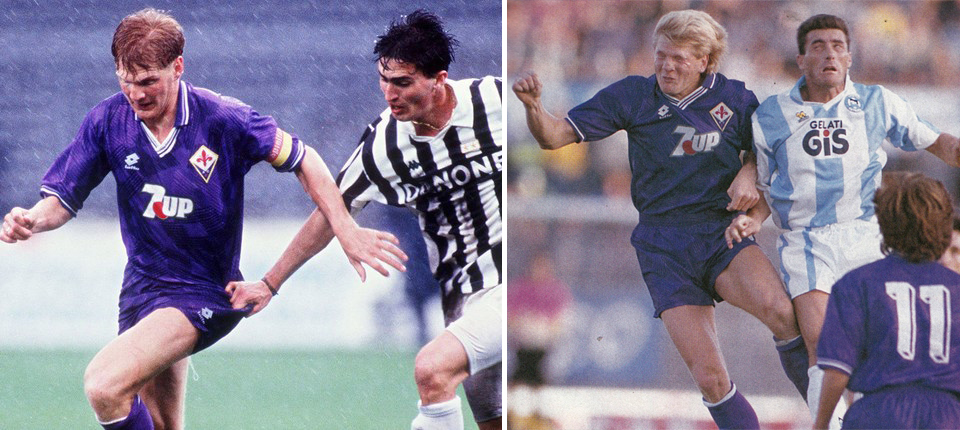
The man asked to lead the club back to Serie A was Claudio Ranieri. The former Napoli coach decided that Serie B was the perfect place to thrust a handful of promising youth talents — including goalkeeper Francesco Toldo and forwards Anselmo Robbiati and Francesco Flachi — into the first team. These additions joined an already strong squad. Although Laudrup was quickly offloaded to Italian champions Milan, the rest of Fiorentina’s players seemed content to help the side out of the mess in which it now found itself. Batistuta and Effenberg were commended for showing such loyalty at the risk of losing their places in their respective national sides, and in a World Cup year no less. The Argentine, now known by the Florentine faithful as “Batigol”, again found the net sixteen times during the 1993-94 campaign, atop a scoring chart that also included future Serie A legends Oliver Bierhoff (Ascoli), Enrico Chiesa (Modena), Filippo Inzaghi (Verona) and Christian Vieri (Ravenna).
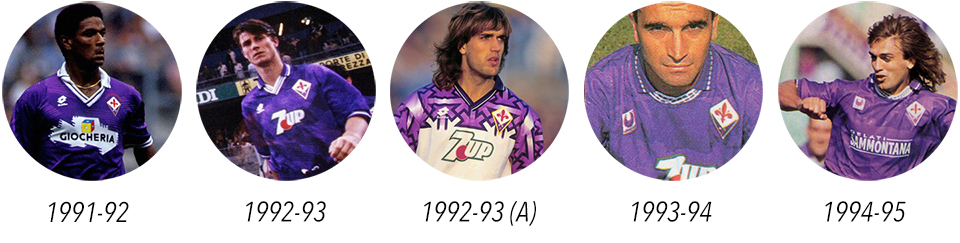
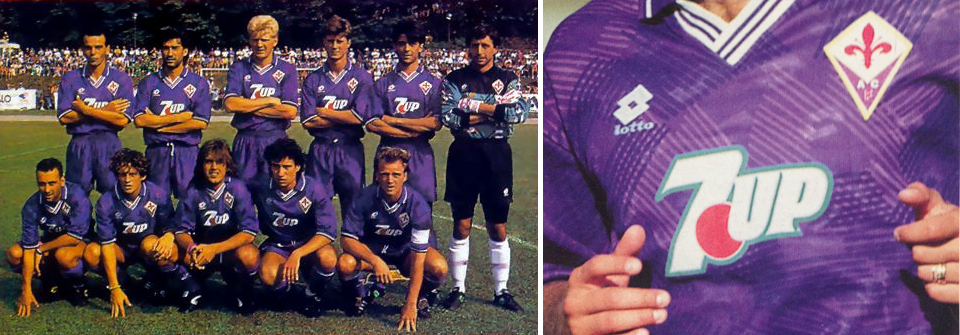
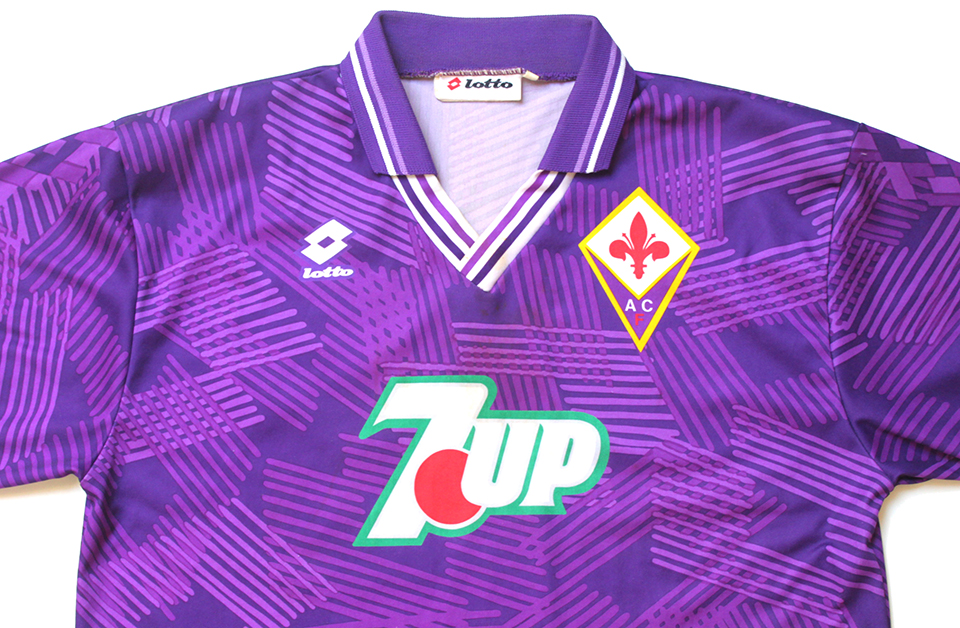
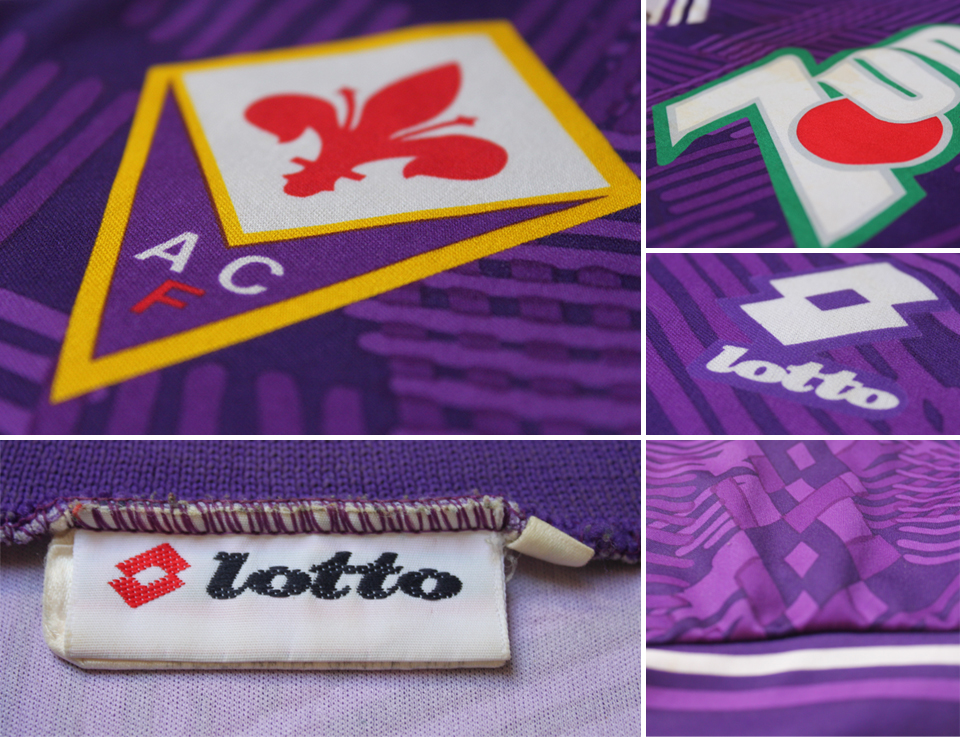
Fiorentina’s kit from 1991 to 1993 was produced by Lotto, in a design that matched the template worn by the Dutch national team in the same period. In 1991 the club ditched the stylised “F” logo reverted to a traditional kite-shape crest. In 1992 the shirt saw small modifications to the collar and sponsor, which changed from Giocheria (an Italian toy company) to the internationally-recognised soft drink 7-Up. It was Fiorentina’s away shirt that season that drew most attention for its unfortunate swastika-like motif hidden within the purple pattern across the sleeves and shoulders. The shirt was worn in four away games before the now infamous design flaw was pointed out, after which la Viola reverted to a plain white strip. I bought the 1992-93 home shirt from Casa dello Sport, a veritable mecca for football shirt enthusiasts located in Via de’ Tosinghi in the heart of Florence’s centro storico (I later picked up the shorts and socks to match). Fiorentina kept the same look during their season spent in Serie B, although the kit was now manufactured by the German company Uhlsport. When the side returned to Serie A in 1994 a new sponsorship deal was struck with Tuscan ice cream company Sammontana.
My first ever visit to the Stadio Artemio Franchi occurred while la Viola‘s were languishing in Serie B, in a league fixture against Modena in April 1994. The match was played under a torrential downpour; ironically Fiorentina’s free-flowing goalscoring form had completely dried up, and the game finished goalless. Nevertheless, in the end Fiorentina bounced back to Serie A comfortably, eventually finishing on top of Serie B, five points ahead of second-placed Bari. Sadly Mario Cecchi Gori didn’t live to see the side gain promotion, having died in late 1993, at which point the club was taken over by his son, Vittorio. With Effenberg returning to Borussia Mönchengladbach following promotion, the club now needed to bolster their squad if they were to make an impact in Serie A. Brazilian Marcio Santos arrived from Bordeaux, having just won the World Cup in the United States. But the central defender’s time in Florence was brief, and he moved on to Ajax after a single season in Italy. Fiorentina’s other big signing fared a little better. Manuel Rui Costa had broken into Benfica’s first team as a teenager and was already an established name in the Portuguese national side. To the delight of the Viola fans, the young Portuguese playmaker developed an immediate understanding with Batistuta, who found the net in the first eleven games of the season, beating a record held since the 1950s by Ezio Pascutti of Bologna. With his twenty-six strikes that season, the Argentine also equalled Kurt Hamrin’s record of most goals scored by a Fiorentina player in a single league campaign. But despite “Batigol” more than living up to his nickname, and Rui Costa’s emergence as one of Serie A’s finest number tens scoring, Fiorentina’s form began to slip after the new year, and they eventually finished a disappointing tenth, failing to qualify even for the UEFA Cup.
Yet the disappointment was tempered with the fact that Fiorentina had finally turned a corner. The nightmare of relegation was behind them, and in Batistuta they’d found a new hero to take over the mantle of Baggio. Over the next few seasons Fiorentina continued to grow stronger, with Batistuta, Rui Costa and Toldo remaining key men in a side that ultimately began to challenge for top honours at home and in Europe. But just when it seemed the club was enjoying its best spell in years, so the fun came to an abrupt halt. The 1990s had been certainly been a rollercoaster of a decade for Fiorentina, but it was nothing compared to what was to come, as la Viola entered the most turbulent and dramatic period in its history.
Coming soon…
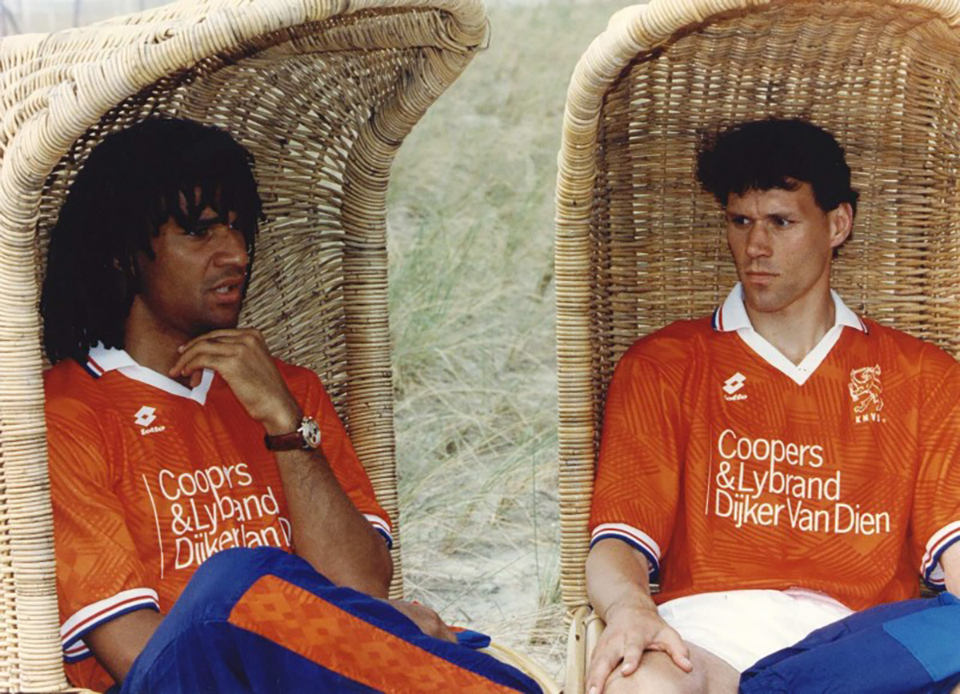
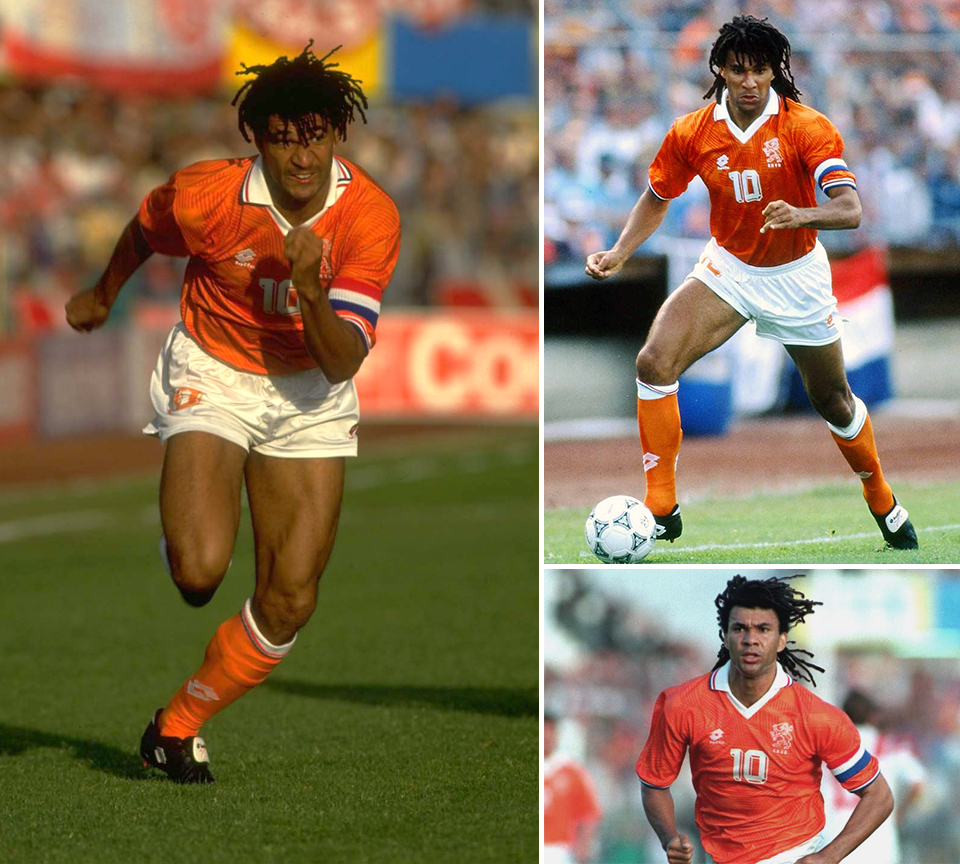
When Holland won the 1988 European Championship it not only secured their first major international trophy but also ended a long period in the wilderness. The Dutch had been unlucky to lose consecutive World Cup Finals in the 1970s, but had then failed to qualify for neither the 1982 or 1986 competitions, nor the European Championships in 1984. So impressive was the victory in West Germany that much was expected of the Dutch side that arrived at the 1990 World Cup. In the interim the trio of Ruud Gullit, Marco Van Basten and Frank Rijkaard had helped make Milan the continent’s most feared club side, winning back-to-back European Cups. Unfortunately a series of managerial switches between qualification and the start of the tournament had left the squad tense, unstable and prone to internal bickering. Meanwhile, Holland’s star players failed to show their true worth. Gullit was still recovering from injury, Van Basten failed to find the net, and Rijkaard compounded a miserable tournament by getting sent off in the defeat against West Germany for spitting on Rudi Völler.
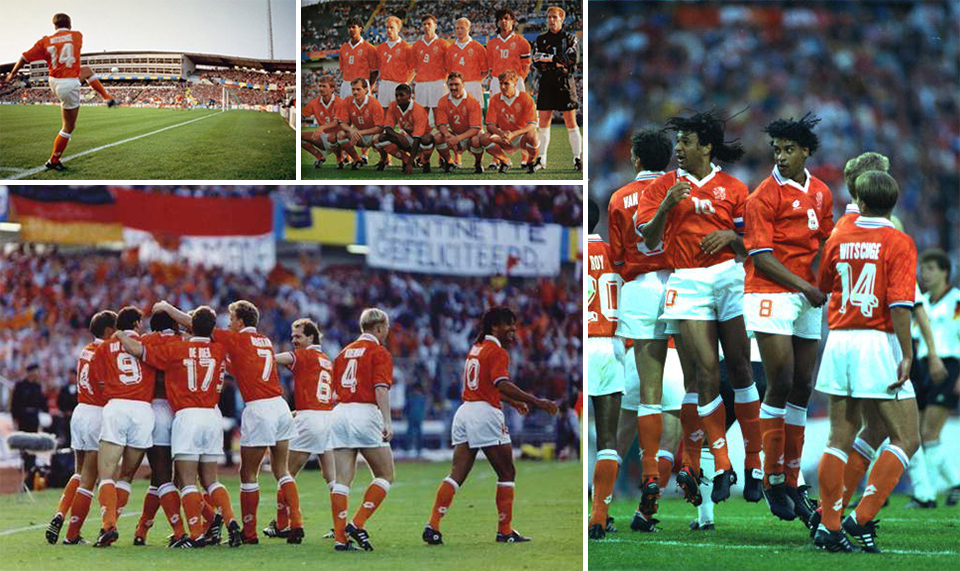
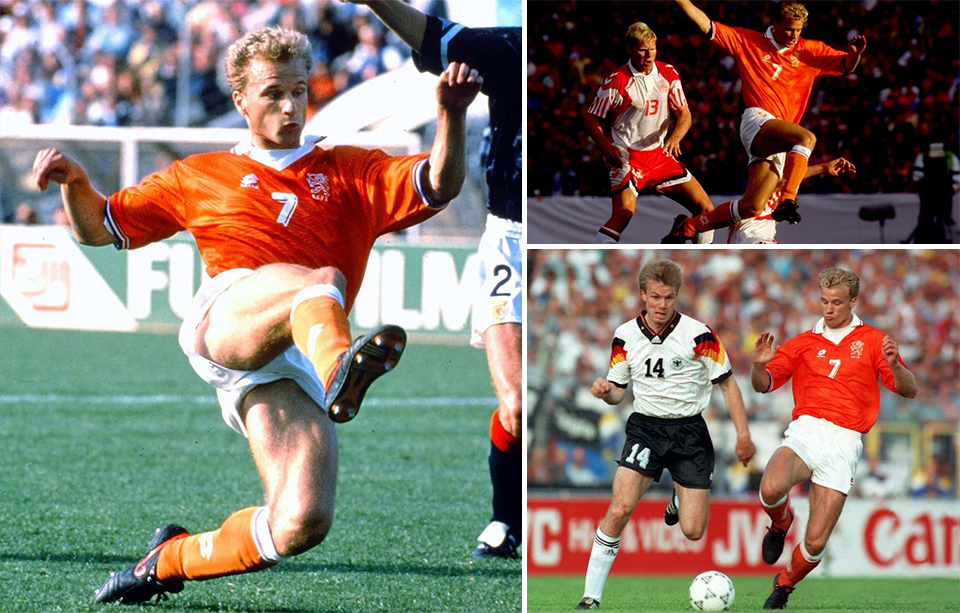
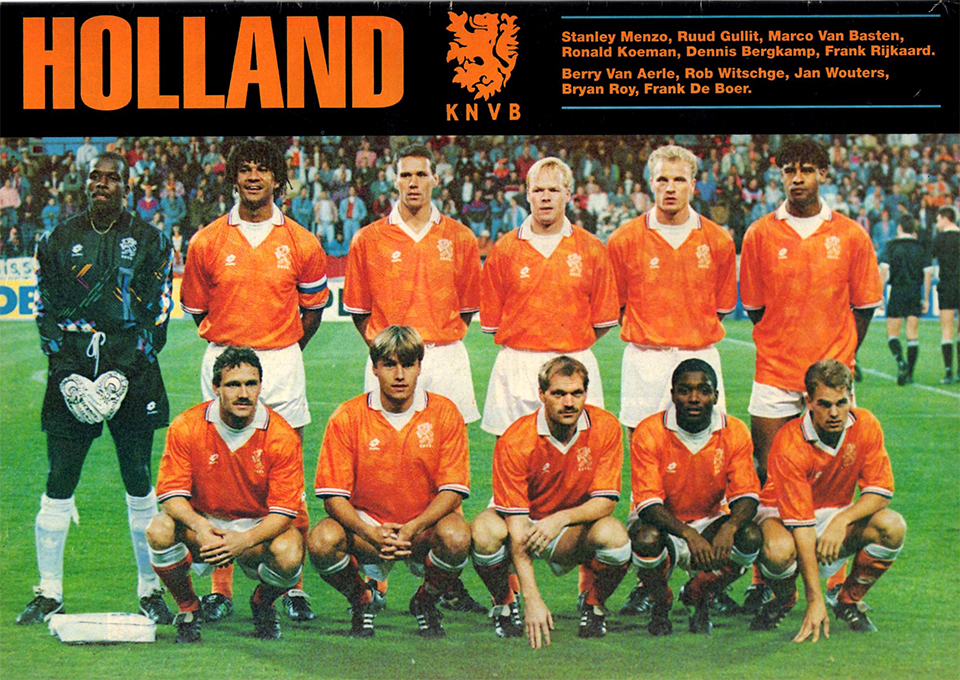
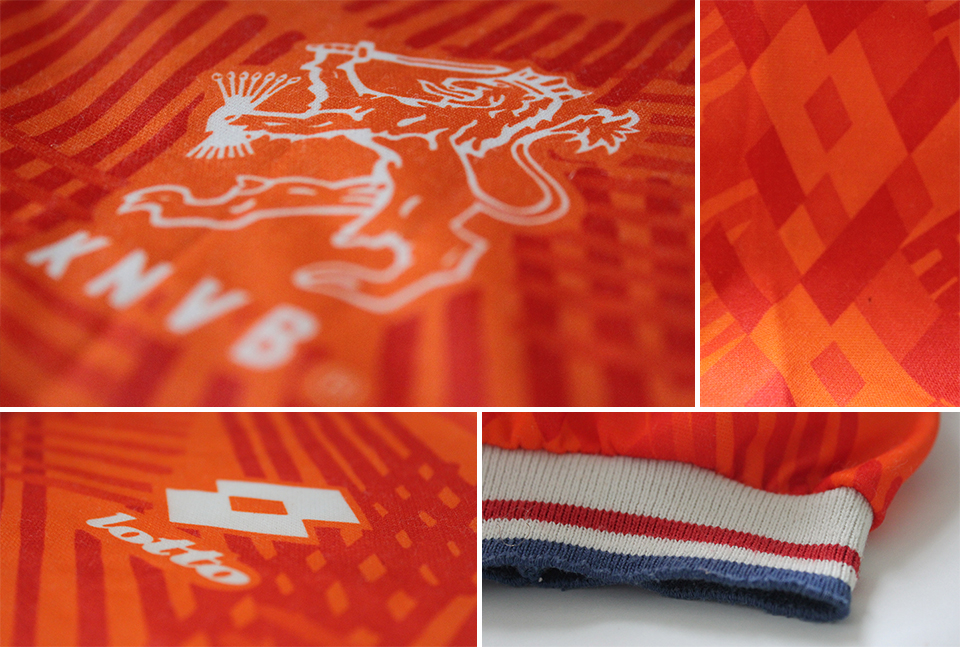
The man who had led Holland to their ’88 triumph, Rinus Michels, returned to the Dutch bench in time for the 1992 European Championships in Sweden. Michels had spent his entire playing career at Ajax, and as a coach became the truest practitioner of the Amsterdam club’s concept of “Total Football”. The philosophy’s greatest disciple on the pitch, Johan Cruyff, played under Michels at both Ajax and Barcelona, not to mention the national team that dazzled at the 1974 World Cup. By the early nineties the free-flowing nature of those sides had been reigned in, but elements of the style remained. The most noticeable difference to the Dutch side was its kit. The KNVB’s long-standing relationship with adidas had ended at the close of 1990; in a qualifier against Malta in March 1991 Holland debuted a new kit produced by Italian company Lotto. The shirt’s most marked characteristic was a unique pen-effect pattern woven into the fabric that echoed the brand’s logo. The white collar and cuffs featured a red-white-and-blue tri-colour trim in the style of the now familiar Italy shirt. Even the 3D numbers were the same as those worn by the Azzurri. It’s also worth noting that this was the first major senior tournament to incorporate front numbers and names on the back of shirts. Although only one member each of the three Dutch sets of soccer-playing brothers — Koeman, Witschge and De Boer — made the Holland squad, the initiative did prove handy in helping to distinguish between mustachioed defenders Van Tiggelen and Van Aerle (not to mention the various Anderssons and Nielsens in the Sweden team).
Michels selected twelve players from his successful ’88 squad, the same twelve that had also gone to Italia ’90. This experienced group provided the backbone of the Holland side that attempted to defend their title. Two young additions to the team were elegant forward Dennis Bergkamp and winger Bryan Roy, both from Ajax. It was Bergkamp who made his mark early on the tournament, scoring the only goal of Holland’s first match against Scotland. A goalless draw against the CIS (a provisional post-Soviet national team following the break-up of the USSR) was enough to see the Dutch through to the semi-finals, but there remained the small matter of a grudge match against Germany. A late Van Basten goal had beaten the West Germans in the ’88 semi-final in Stuttgart; two years later West Germany had knocked Holland out of the World Cup in Milan. Now they met for the third tournament running in Gothenburg, where the Dutch sailed into an early two-goal lead through a Rijkaard header and a low drive by Feyenoord’s Rob Witschge. Jürgen Klinsmann pulled a goal back after the interval but Bergkamp scored his second headed goal of the tournament to seal a memorable 3-1 win.
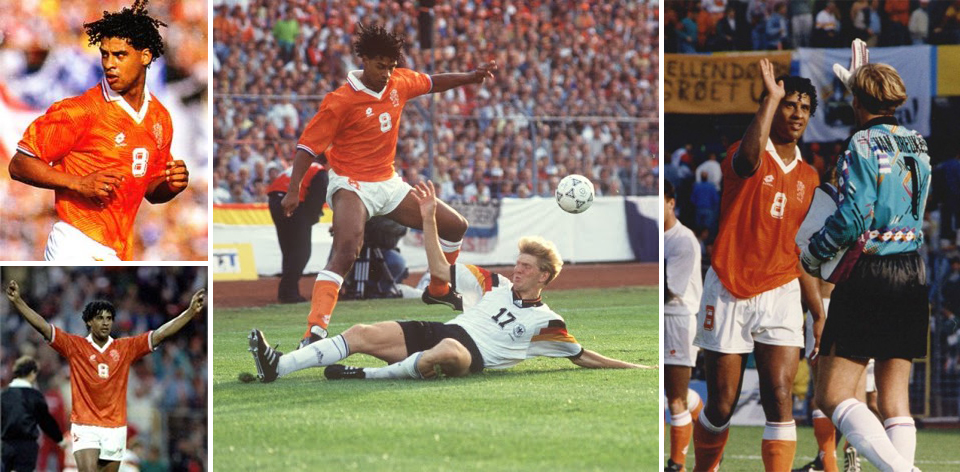
In their semi-final Holland faced surprise package (and eventual tournament winners) Denmark, who were only competing in Sweden due to war-torn Yugoslavia’s late disqualification. Bergkamp and Rijkaard were again on hand to respond to Henrik Larsen’s double strike, forcing the game into extra-time and towards the inevitable shoot-out. Four years earlier Dutch goalkeeper Hans Van Breukelen had saved from Benfica’s final penalty to win the European Cup for PSV Eindhoven. But this time it was his opposite number Peter Schmeichel who stopped the decisive kick, from the right foot of Van Basten no less. It was a sad end to another disappointing tournament for the striker. A textbook volley that crashed against the German crossbar proved to be the only glimpse of the devastating form he’d shown in 1988.
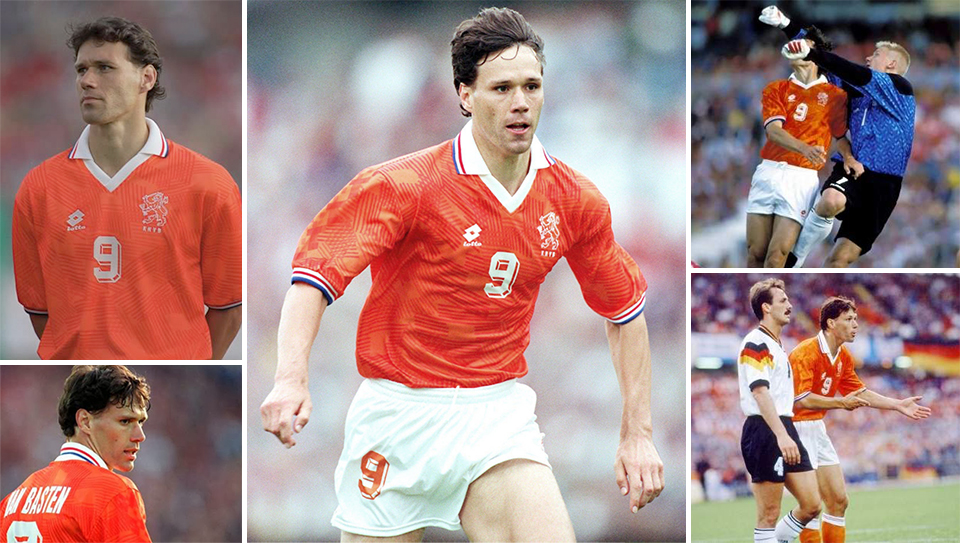
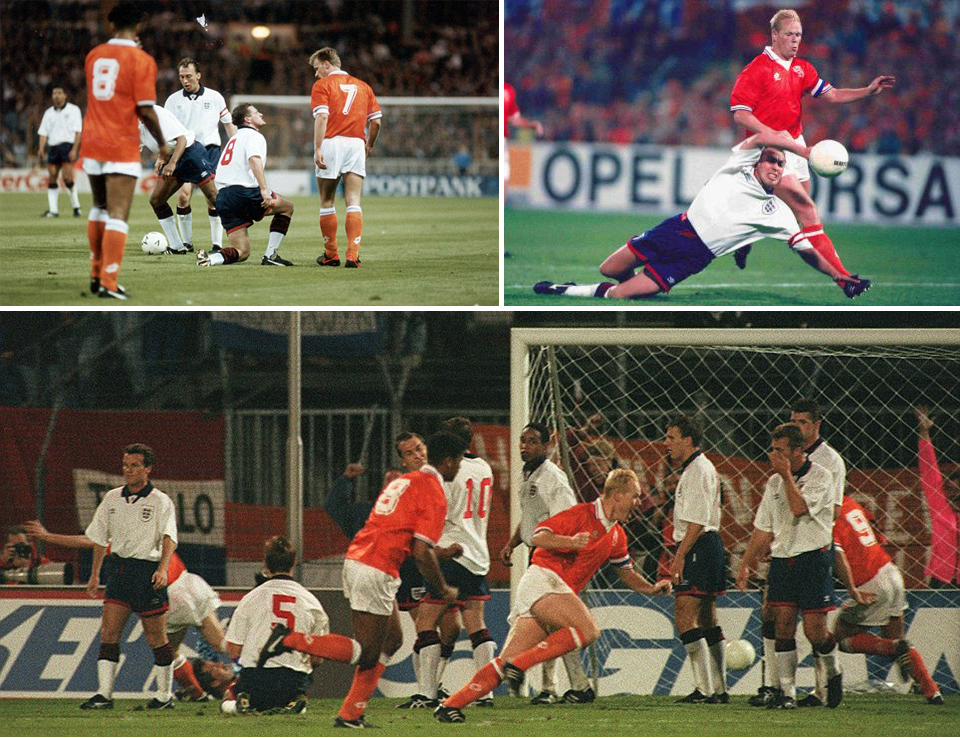
I didn’t wear my Holland shirt at Wembley the night the Dutch visited England for a World Cup qualifier. Though I was delighted to see two of my idols, Gullit and Rijkaard, in the flesh, I was still not over the disappointment of discovering that Van Basten had been ruled out of the game due to an ankle injury — one from which he never recovered. The striker did return In May to play a couple more games for Milan, including the European Cup Final defeat to Marseille which proved to be his final professional appearance. After conceding two early goals — the first an expertly taken free-kick by John Barnes after a few seconds — Bergkamp got one back at the other end, deftly lobbing Chris Woods in the England goal. Late in the second half pacy central defender Des Walker for once struggled to keep up with his opponent, and was compelled to bring down 20-year-old Ajax winger Marc Overmars inside the box. Subsitute Peter Van Vossen converted the kick to earn the Dutch a point.
Surprisingly, Norway were proving the strongest side in the group. Having lost in Oslo earlier in the summer, England could now not afford to lose their return match against the Dutch in Rotterdam the following October. But lose they did, prompting Graham Taylor’s infamous “Do I not like that” remark. Holland sealed the points with two goals in quick succession, the first a cleverly chipped free-kick from Koeman. English fans argued that the defender should have already received a red card for a professional foul on Platt. Bergkamp headed a second a few minutes later, and England’s hopes of qualifying for USA ’94 were effectively over.
At the 1994 World Cup the Dutch wore an almost identical shirt, the only changes being the shirt’s background pattern (that now featured a repeated KNVB crest) and the replacement of the 3D numbers with a more conventional flat white font. The team were already without Van Basten, who hadn’t played since May ’93, and on the eve of the tournament lost Gullit, who after a long-running feud with coach Dick Advocaat stormed out of a training session. Neither player would ever play for his country again. So Rijkaard was one of only four players from the ’88 squad still involved with the national team. In the stifling heat of Orlando the Dutch stuttered through their group: a defeat against neighbours Belgium was sandwiched between two narrow victories over Saudi Arabia and Morocco. Yet somehow they finished on top having scored more goals against their direct rivals. The speed of Bergkamp and Overmars made easy work of an exhausted Ireland in the second round, but in the quarter-final in Dallas the Dutch succumbed 3-2 to eventual winners Brazil.
Holland’s second goal in that defeat was scored by Aron Winter. With Rijkaard, Koeman and Wouters having all retired from international football after the World Cup, the Lazio midfielder remained the only survivor from 1988 included in Guus Hiddink’s squad for the 1996 European Championships. For the tournament in England Holland’s Lotto shirt underwent further modifications. A button-up collar was added, while the tricolour trim became a broken stripe resembling something akin to morse code. The shirt fabric incorporated the image of Dutch players celebrating a goal at USA ’94. On the pitch Holland struggled again, drawing 0-0 with Scotland and beating Switzerland. Only a late Patrick Kluivert consolation goal in a 4-1 defeat against the hosts saw them through the group on goals scored. In the quarter-finals they lost to France on penalties after another goalless draw.
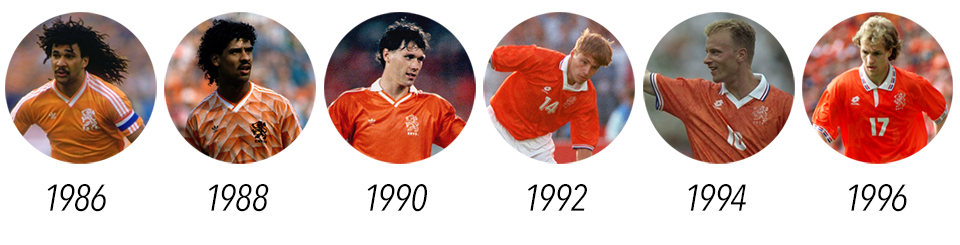
Euro ’96 was the last tournament in which the Dutch wore Lotto. For the 1998 World Cup in France they had struck a deal with Nike, whose uniforms they have worn ever since. Winter remained a part of the international fold for that tournament and was even selected for the one that followed — Euro 2000, which Holland co-hosted — by old teammate Frank Rijkaard, who was now in charge. Several of Holland’s Nike shirts have made great use of black as a secondary colour (which was totally absent from all the Lotto kits), presumably in an attempt to reference past glories. But none have inspired the team to a second international success, just as I have yet to be compelled to add any of them to my collection. Personally I thought the 1988 kit was hideous at the time, an opinion which has not changed despite its recent new-found status of cult favourite (a case of a lousy shirt being elevated alongside a winning team). I much preferred the clean kit worn at Italia ’90 and the Italian style Lotto strip sported at Sweden ’92. That was also the last time Gullit, Rijkaard and Van Basten played together, and the last time I genuinely enjoyed watching the Dutch — none of which can be a total coincidence.

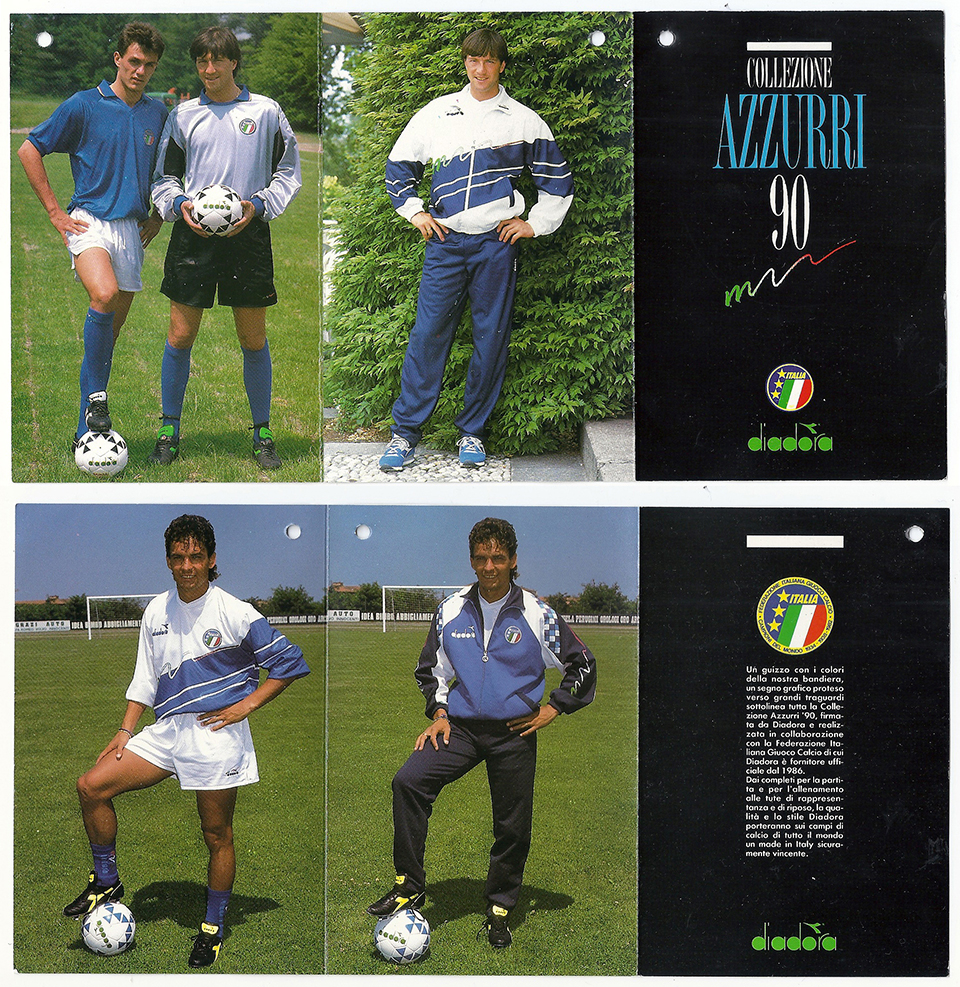
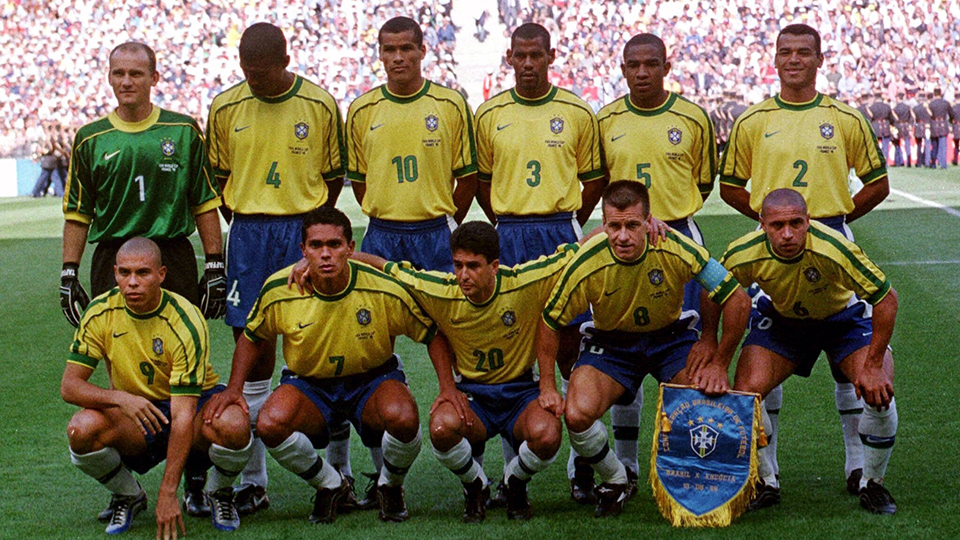
Every collection has to begin somewhere, and mine began here. Prior to the 1990 World Cup my interest in football had been casual at best. I had vague recollections of Maradona’s Argentina triumphing in Mexico, but as Italia ’90 approached so my imagination and enthusiasm began to pique. I’d spent months researching the teams, players and history of the competition and avidly collecting the stickers, and I was counting the days until the tournament started. One day, while out shopping with my parents, we stopped inside a sports shop where I got to study the national team jerseys up-close for the first time. Like many young fans enamoured by the epic romance of the World Cup, my eye was first attracted to the yellow of Brazil, though the 1986 model I had admired in photographs had been replaced by the ’90 version, the updated collar of which I didn’t much care for (I finally got my hands on the ’86 shirt almost twenty years later). And so instead my attention swung to the Azzurri blue of Italy.
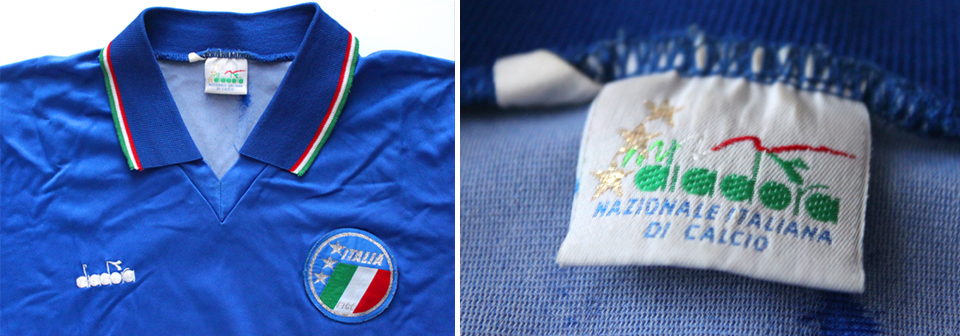
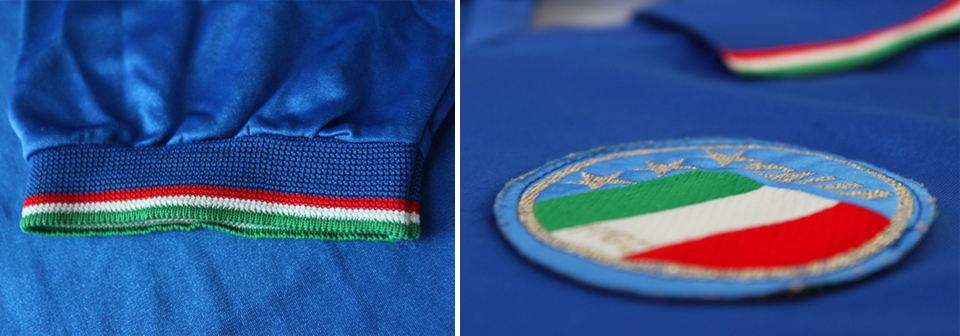
In hindsight it seemed the obvious choice. I’d spent the last two summers in Italy, visiting Florence, Rome and Venice, and slowly absorbing the country’s passion for calcio. Moreover, that summer Italy would be hosting the world’s greatest sporting event, and their young and exciting team was expected to go far. I walked out with a brand new Italy shirt, size XL boys (I remember it cost £19.99), and a new allegiance had been born.
Incredibly, the shirt’s design was already five years old, remaining unchanged from that used by the Azzurri at the 1986 World Cup and 1988 European Championships, which itself was essentially an updated version of the kit worn by Italy’s world champions in Spain in 1982 (which had been produced by Le Coq Sportif). This seems unthinkable today, when teams release new uniforms practically once a year. Imagine the hosts of a major tournament not cashing in on a redesigned shirt to commemorate the occasion! The only difference (that I can detect) to the 1990 incarnation, was that the already iconic tricolore stripes that ran along the edge of the collar and cuffs were inverted, meaning the red stripe was on the outside (this was only true of the players’ shirts, not of those sold commercially).
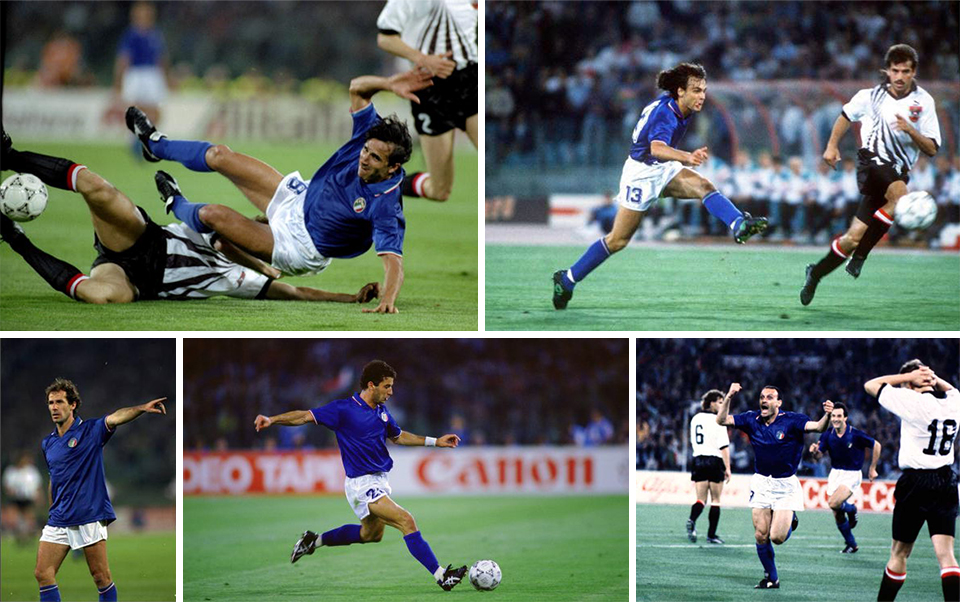
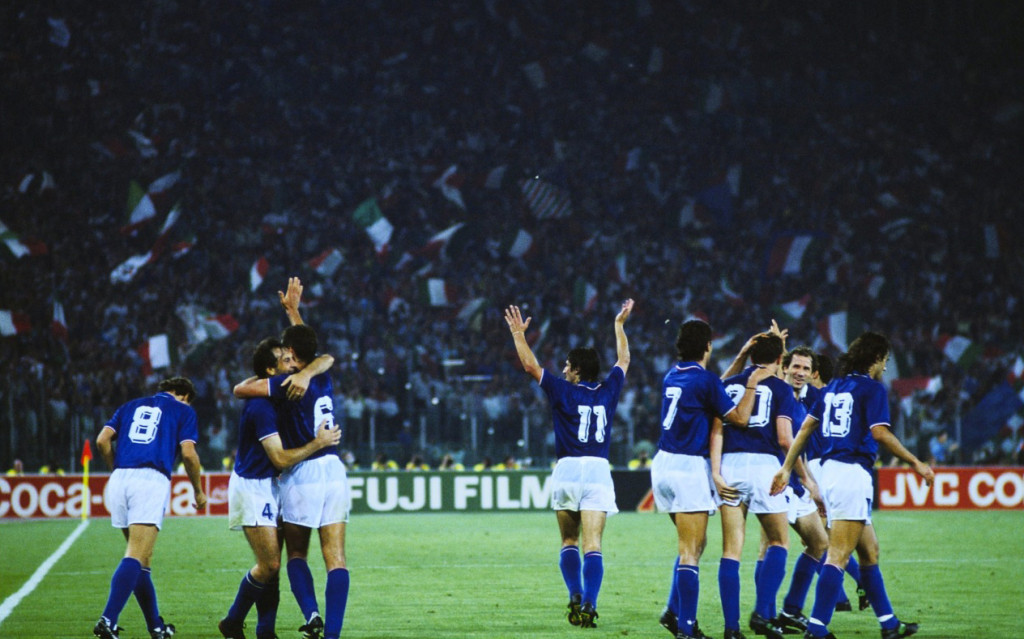
Italy opened their campaign against Austria in Rome on June 9th. It was a Saturday night: Argentina had lost to Cameroon in the opening match the day before and that afternoon I’d watched Romania beat the Soviet Union. This was my first time watching the Italian national team on live television and before kick-off it was clear from the pictures and atmosphere that there was a tremendous sense of occasion and anticipation. The Sampdoria striker Gianluca Vialli had been touted as a potential star of the tournament, and he was paired up front with Napoli’s Andrea Carnevale. Italy played at a relentlessly high tempo and were full of creativity, but were constantly thwarted by the Austrian keeper Lindenberger. I remember my mum saying how attractive some of the Italian players were and that she felt sorry for Carnevale when he was substituted with sixteen minutes remaining. His replacement was another forward, Salvatore Schillaci. The balding Sicilian had earned just one cap prior to the tournament in a friendly against Switzerland the previous March, in which he’d failed to make any impact. Few could have imagined that his late entrance would alter the course of Italy’s World Cup so dramatically. Less than two minutes later Schillaci got on the end of Vialli’s perfect cross and headed in the winning goal, to the palpable relief of a packed Stadio Olimpico.
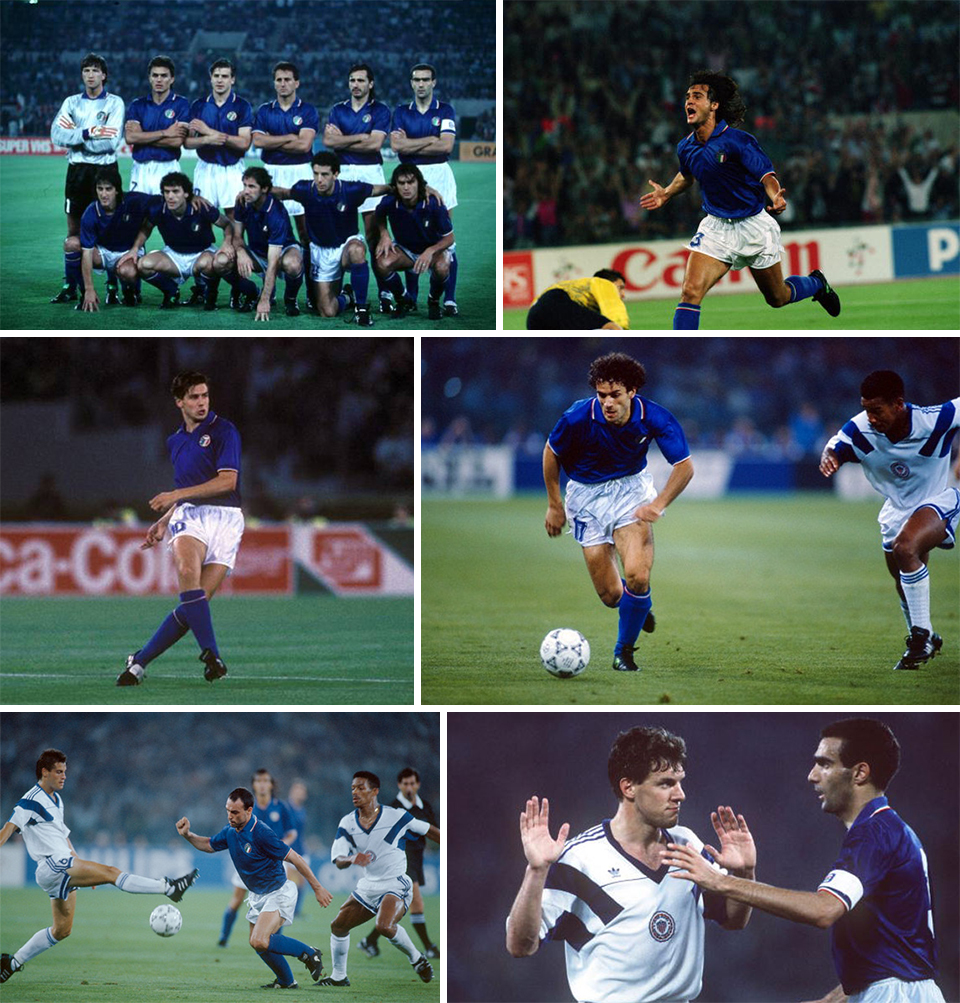
The Italian manager Azeglio Vicini stuck by his front two for the following game with the United States. But again Carnevale failed to score, and again he was replaced by Schillaci, this time after less than an hour. Vialli didn’t fare much better, striking a first-half penalty against the post. By that time the Italians were already in front: hometown favourite Giuseppe Giannini having fired a left-foot shot past Meola after only eleven minutes. There were no further goals, but a second narrow victory against less than formidable opponents satisfied neither fans nor press. Perhaps ceding to pressure, Vicini gave Schillaci his first start in the final group match against Czechoslovakia, while an injury to Vialli prompted the coach to include Italy’s most promising star, Roberto Baggio, in the line-up. The young talent had finished the 1989-90 season as Serie A’s second-highest top scorer in a Fiorentina side that had reached the final of the UEFA Cup. Since then Baggio had become the world’s most expensive player following a controversial transfer to Juventus.
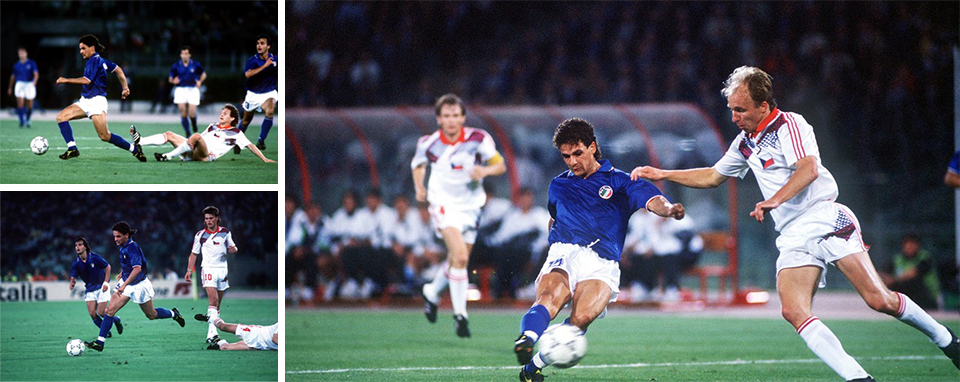
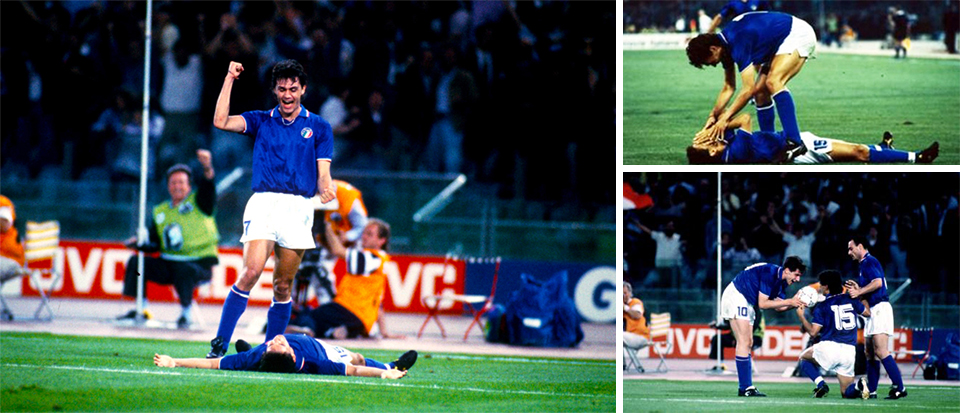
As often happens in major tournaments, Vicini had stumbled upon his best side by accident. Italy’s new attacking partnership, aided by the runs of the galloping Inter midfielder Nicola Berti, proved more than a handful for the Czech defence. Schillaci scored his second goal of the tournament (with another header) after just nine minutes. Though the Czechs were unfortunate when Griga’s perfectly good equaliser was ruled out for offside, the match is forever remembered for Baggio’s solo effort on 78 minutes. Receiving the ball on the half-way line, the young forward played a one-two with Giannini, evaded Hasek’s challenge, and after entering the area deployed a devastating feint that deceived both the last defender, Kadlec, and Stejskal in the Czech goal. Baggio was left with the relatively simple task of stroking the ball inside the near post. Italy’s new star raced away and quickly collapsed to the ground, as it perhaps dawned on him that he’d just scored one of the great World Cup goals. British commentators on both BBC and ITV coud barely contain themselves, and had to scream to be heard over the noise in the Olimpico. Over on the Italian station RAI, Bruno Pizzul seemed at a loss for words. His initial comment — “veramente bravo” — hardly did the goal justice, but as the action was replayed he happened upon a more poetic turn of phrase: “Un pezzo di antologia calcistica.”.
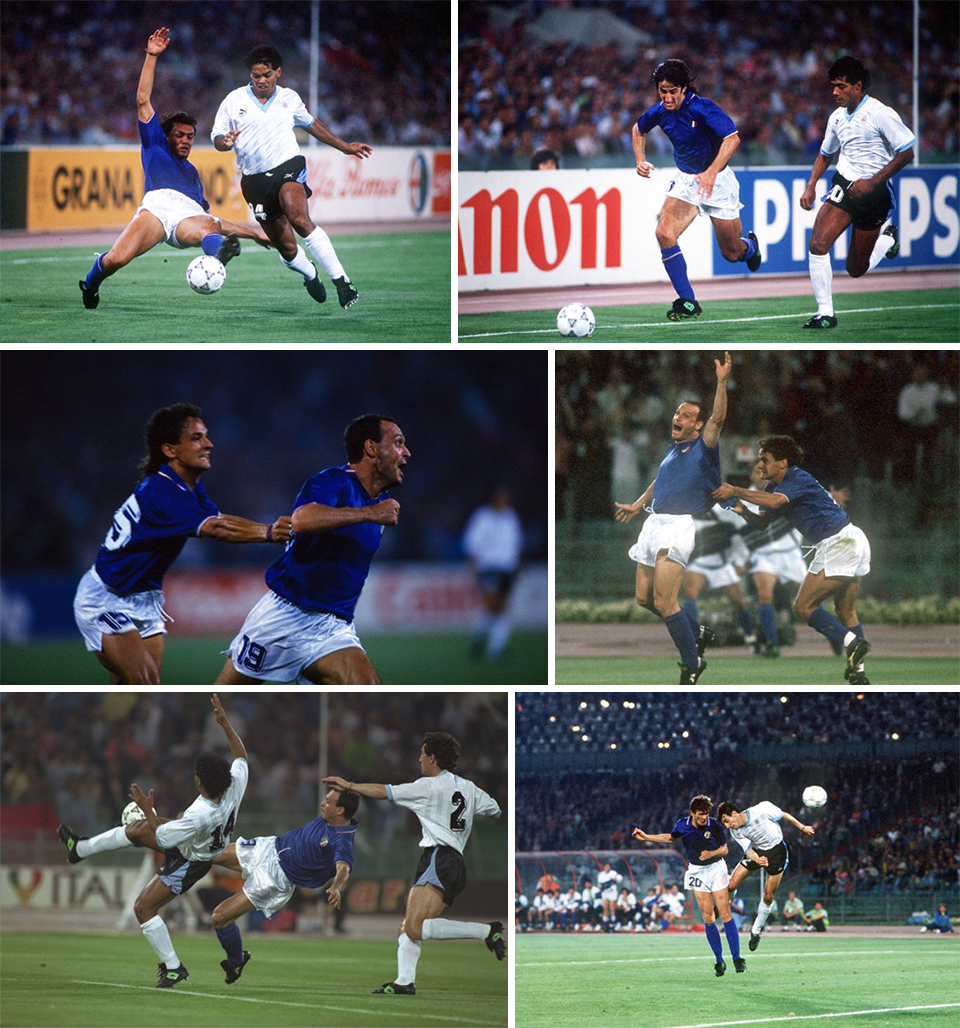
Having already sealed the victory with the goal of the tournament so far, Baggio’s place in the side was surely secured. More importantly, the victory meant Italy would stay in Rome to play Uruguay in the second round. Predictably, the South Americans were tough to break down, and in the second half Vicini sent on the Inter forward Aldo Serena, who would certainly provide an aerial threat. Minutes later Serena’s poked pass between Gutiérrez’s legs rolled into Schillaci’s path. As two defenders converged on him, “Totò” released an instinctive left foot shot that flew up over Alvez and under the crossbar. Italy had discovered an unlikely new hero, and no-one seemed more surprised than Schillaci himself. Arms aloft, mouth agape, eyes popping out of their sockets — his celebrations revealed nothing but joy and disbelief, that is until he was duly wrestled to the ground by a posse of delighted teammates. With five minutes left Serena nodded in a simple second — a nice thirtieth birthday present — and the Italians were through.
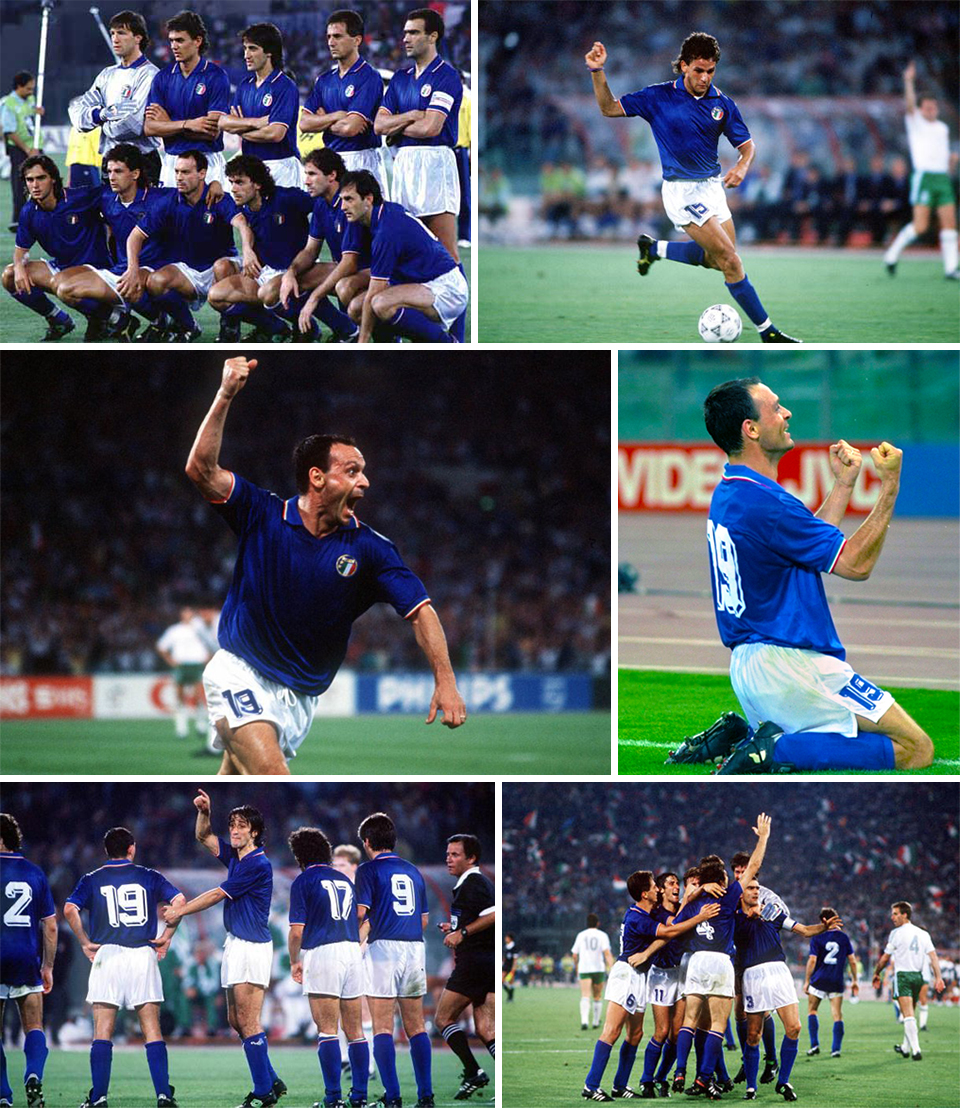
With the country gripped by Totòmania, the Italy team marched with confidence into its next encounter against World Cup debutantes the Republic of Ireland. The Irish squad had been granted a reception with the Pope prior to the match, but neither this nor “Big” Jack Charlton’s World Cup pedigree was enough to knock out the hosts. Almost inevitably, Schillaci was once again Italy’s goalscorer, this time with a tidy poacher’s finish after Bonner could only parry Donadoni’s drive from distance. In the second half Totò thrashed a free-kick against the crossbar that bounced onto (replays would suggest over) the line. The Azzurri had lost some of the zest they’d shown in the early games, but at this stage only the result mattered.
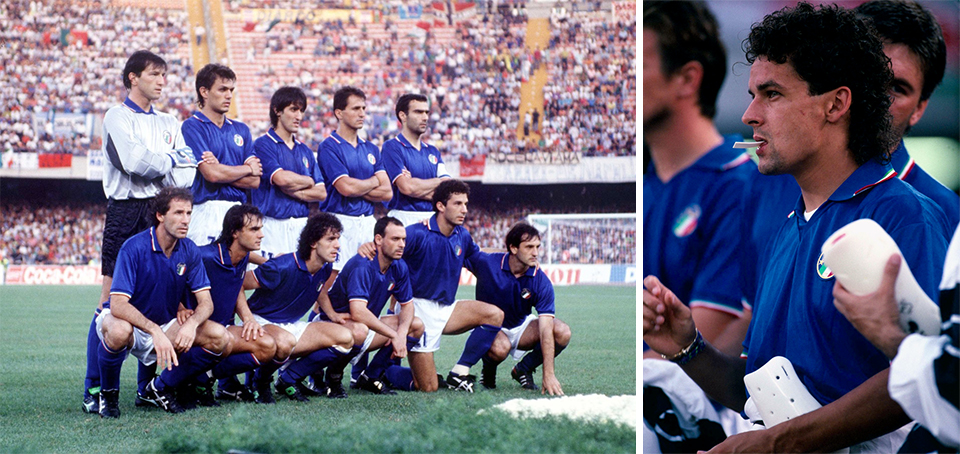
But in the semi-final everything changed — starting with the venue. Italy left their Roman fortress and headed south to face Maradona’s Argentina in Maradona’s Naples. Having just led Napoli to a second scudetto, Maradona now attempted to use his standing among in the city to shift local loyalties away from the hosts and towards the holders. The plan backfired, as evidenced by the banner that greeted the teams as they entered the San Paolo stadium: “DIEGO NEI CUORI, L’ITALIA NEI CORI”. Unfortunately for Italy, Vicini inexplicably tampered with his attacking tandem. Baggio was dropped to the bench, and Vialli, absent since the USA game, started in his place. Nevertheless, the Azzurri opened the scoring after nineteen minutes. Schillaci started a move on the left wing, a determined Giannini forced his way into the box, the ball fell for Vialli whose volley was blocked by Goycochea. The ball fell straight onto the toe of Totò who tapped in the rebound over the Argentine goalie. (The camera switched to a close-up of Vialli, and I remember thinking for a moment that he was the one who’d scored.)
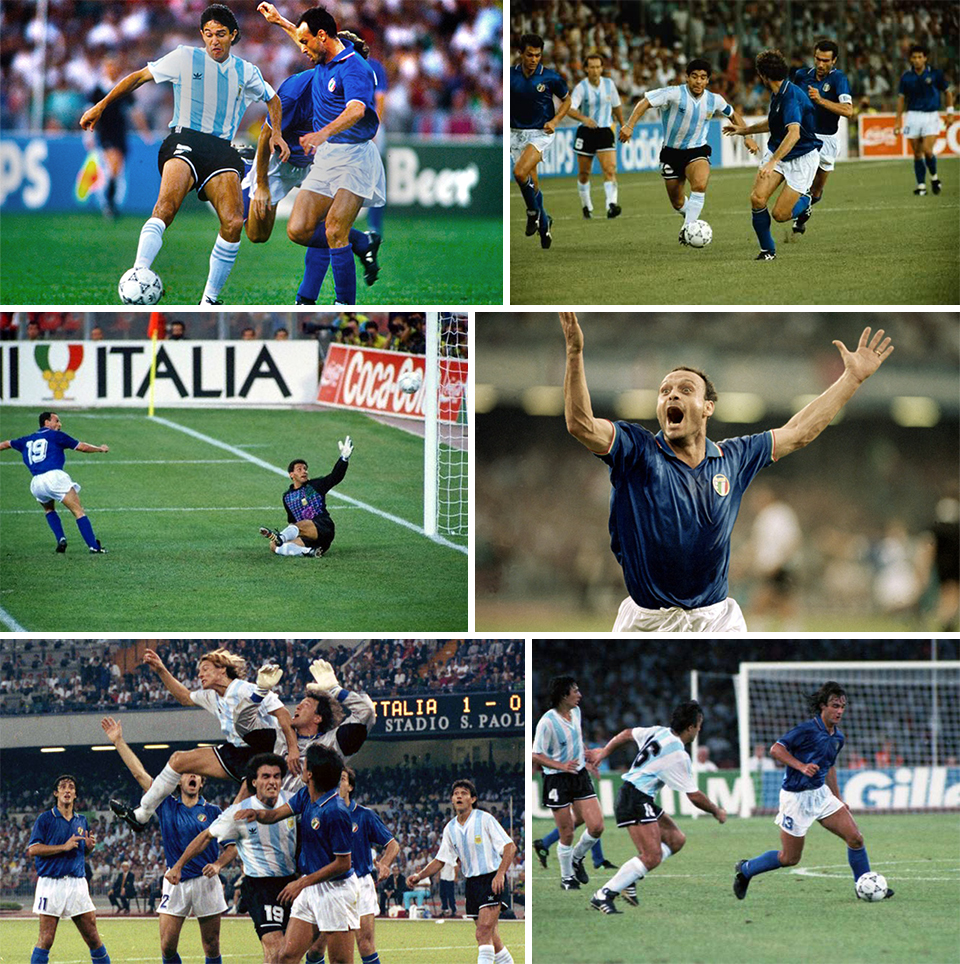
With their noses in front, Italy were in a position to add a second. But Argentina were — for once in the tournament — playing quite well, and as the game wore on, so fear of defeat began to take hold of the Italians’ collective psyche. Deep into the second half Olarticoechea curled in a cross to the near post: Zenga arrived to meet it, but was beaten to the ball by the blond head of Caniggia, whose glanced flick floated into the far corner of the net. It was the first goal Italy had conceded in the competition so far; suddenly their involvement in the final seemed less of a certainty. Fresh legs were required: Vialli made way for Serena, but when Baggio finally came on it was at the expense of Giannini, arguably Italy’s most creative player. In extra-time Argentina’s Giusti was sent off for a supposed elbow on Baggio, the ensuing stoppages for which added a further eight minutes onto the initial fifteen! Any chance of Italy making the extra man count were scuppered immediately when Riccardo Ferri pulled up with a calf strain. Italy had already brought on both substitutes and so the poor defender had no alternative but to spend the remaining minutes hobbling around in midfield. An epic contest inched ominously towards a penalty shoot-out. Argentina had beaten Yugoslavia via spot-kicks in the previous round; for the Azzurri, it was their first experience at this level. Baresi, Serrizuela, Baggio, Burruchaga, De Agostini and Olarticoechea all scored. Then Donadoni, probably Italy’s best player on the night, saw his angled shot parried by Goycochea. Maradona (who’d missed against Yugoslavia) then tucked away Argentina’s fourth with ease. Italian hopes thus hinged on the left boot of Serena. The tall striker struck his kick hard and low, but somehow the keeper got his body behind the ball to block it on the line. The unthinkable had happened. What had seemed a certainty was suddenly an impossibility: Italy would be denied the chance to fight for a fourth world title in Rome. Instead, the superb performances of Goycochea (who’d only come into the side as a result of Pumpido’s leg fracture) had dragged Argentina to a second successive final against West Germany.
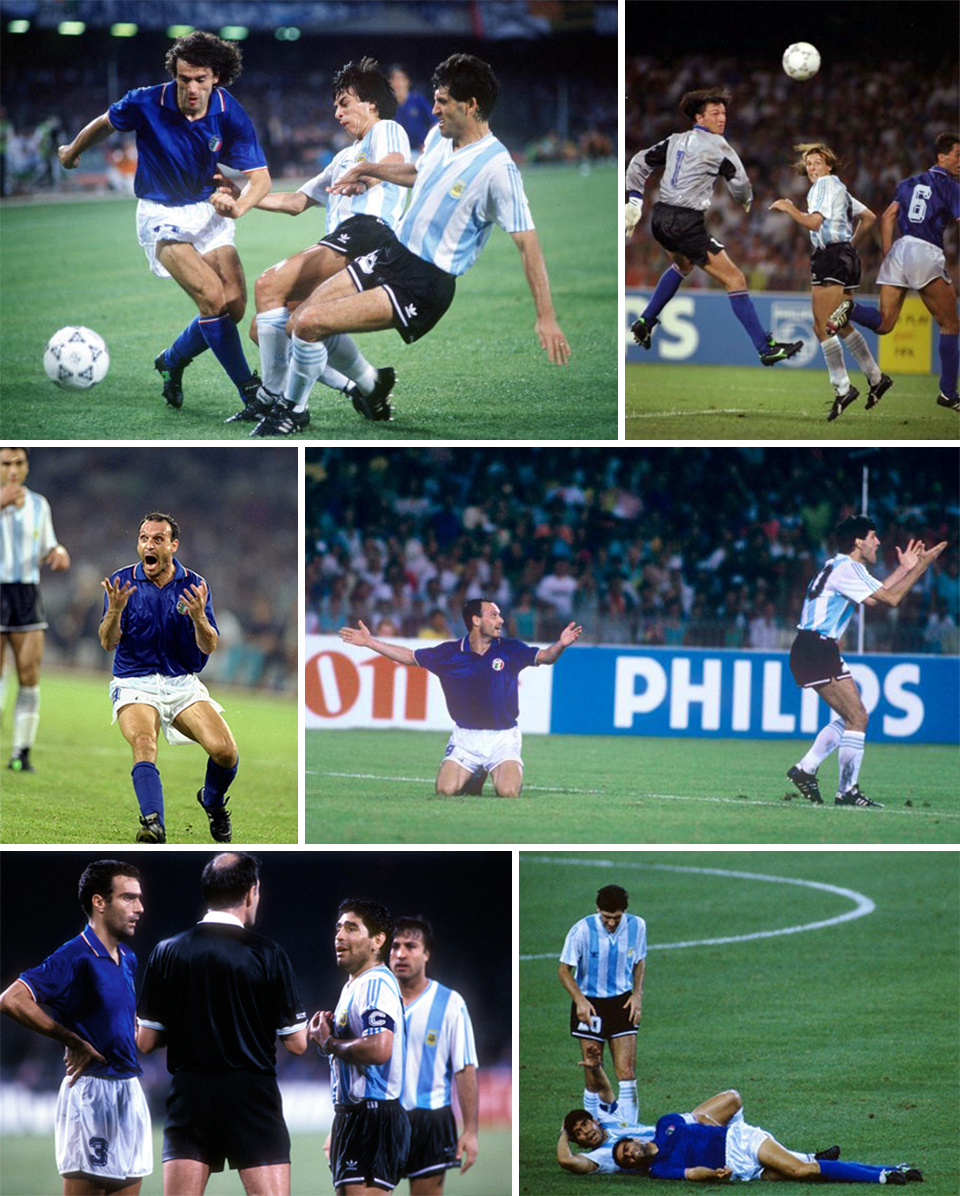
For Italy, an anti-climactic third-place match awaited them in Bari. Their opponents were England, who’d suffered an identical semi-final fate in Turin. Many neutrals — certainly English and Italian fans — felt that this pairing should have graced the final. It was certainly a much better match, and the total opposite of the uninspiring, cynical contest served up the following night. With the pressure now finally alleviated, both managers altered with their starting line-ups, which for Italy meant a rare start for Napoli defender Ciro Ferrara. The game was played in a friendly yet competitive atmosphere of mutual consolation and respect, as if both teams knew the other was still recovering from the bitter blow of a semi-final elimination.
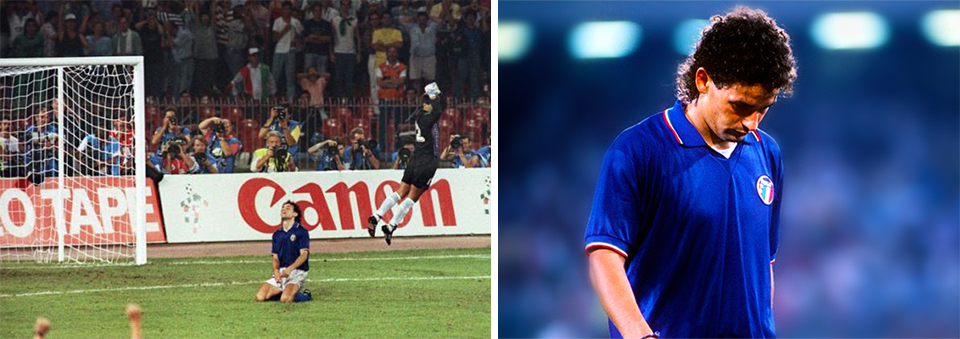

The goals arrived in the final twenty minutes. First, Baggio sneaked in to rob the ball off a dawdling Shilton. With the aging goalkeeper beaten, he played a return pass with Schillaci and lifted the ball over a handful of desperate defenders on the line and into the net. England’s goalscoring midfielder David Platt — who would soon be playing home games at the San Nicola stadium — equalised with a bullet header from a brilliant Dorigo cross. Aside from the victory, Italy’s impetus was also to provide Schillaci with a chance to claim his sixth goal of the tournament, and thus finish as the competition’s top scorer. That opportunity arrived five minutes from the end when the Sicilian stumbled awkwardly over Parker just inside the box. Baggio — Italy’s designated penalty specialist — politely stepped aside and Totò made no mistake, leaving many to wonder what might have been had he been on Italy’s list of five penalty takers the previous Tuesday night. 2-1 would have been 3-1 had Berti’s beautifully angled header on the stroke of full-time not been incorrectly flagged for offside. Consequently Italy’s final moments of the 1990 World Cup were not crowned with one of its best goals, but rather a glaring misjudgment by a slow-witted linesman. The two squads mingled amiably on the podium as they were presented with bronze medals and bouquets. Disappointment still permeated the celebrations, but the night’s positive energy no doubt helped ease some of the pain.
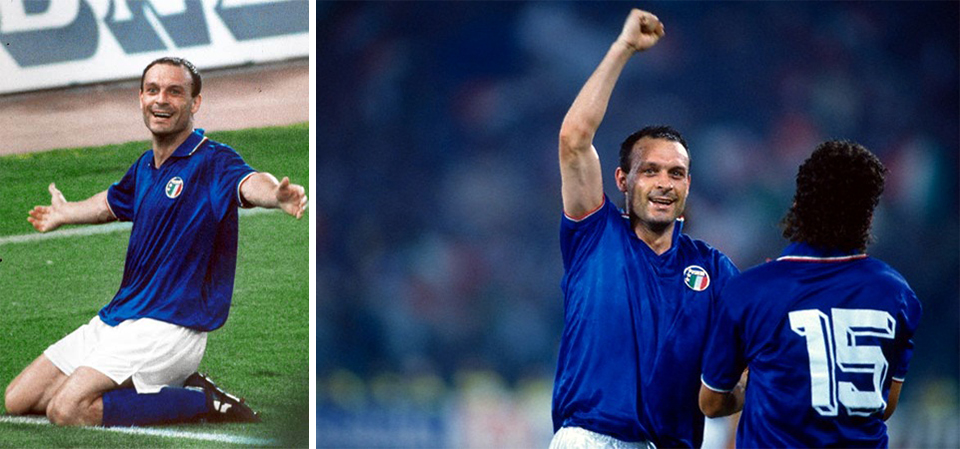
A few weeks later, while on holiday in Italy, my brother and I befriended a group of children at a campsite near Venice. I’d managed to ingratiate myself to the eldest of the group, a boy named Vito from Turin, by wearing my Italy shirt. We spent several long afternoons playing football and communicating through a common love of the game. To this gang of ragazzi my blond younger brother soon became known as “Il Piccolo Gascoigne”. After we’d returned to England, a postcard arrived one day from Turin. On the front was Schillaci, smiling in his Juventus kit; on the back Vito had written “W [Viva] Totò”.
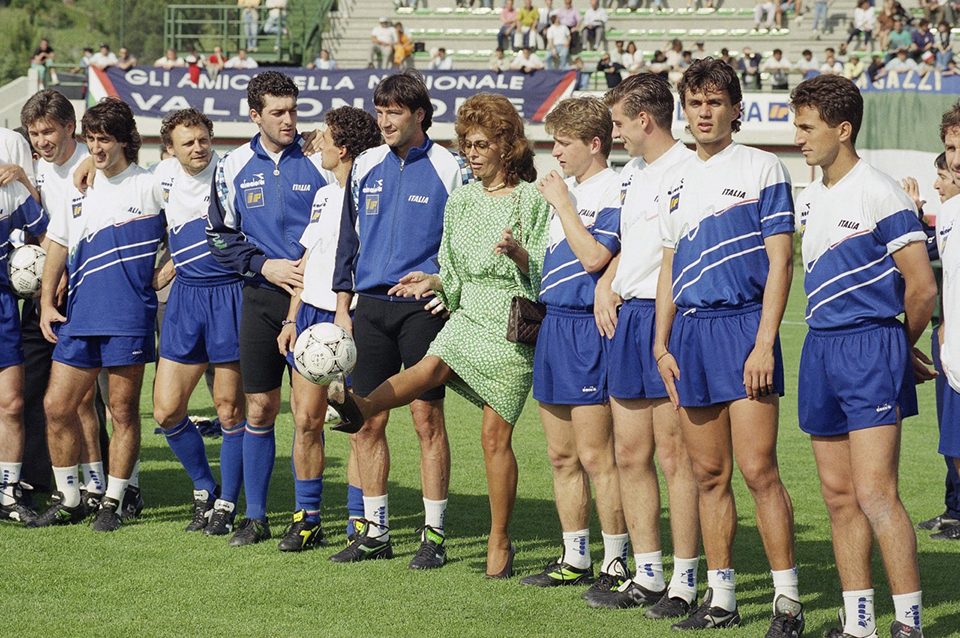
Sadly for Totò the summer of 1990 proved the beginning of the end. Vicini’s six years as coach concluded in 1991 after Italy failed to qualify for Euro 92, and the classic shirt that had characterized his tenure disappeared with him. His successor Arrigo Sacchi brought a wildly different approach to the job, and the international careers of some of Vicini’s squad — including Bergomi, Ferri, Giannini and Vialli — rapidly fizzled out. While Roberto Baggio went on to become Italian (if not world) football’s most recognizable face of the ’90s, Schillaci played his last game for the Azzurri in 1991. He soon left Juventus for Inter, and by the time the 1994 World Cup came around he was playing for Júbilo Iwata in the J-League. In recent years he has resurrected some of his fame through reality television and bit-part acting roles, while running a youth football academy in his native Palermo. Yet Totò is still forever associated with the “Notti Magiche” of 1990 when the Italians proved themselves to be, if not quite the best in the world, at least the best-dressed.
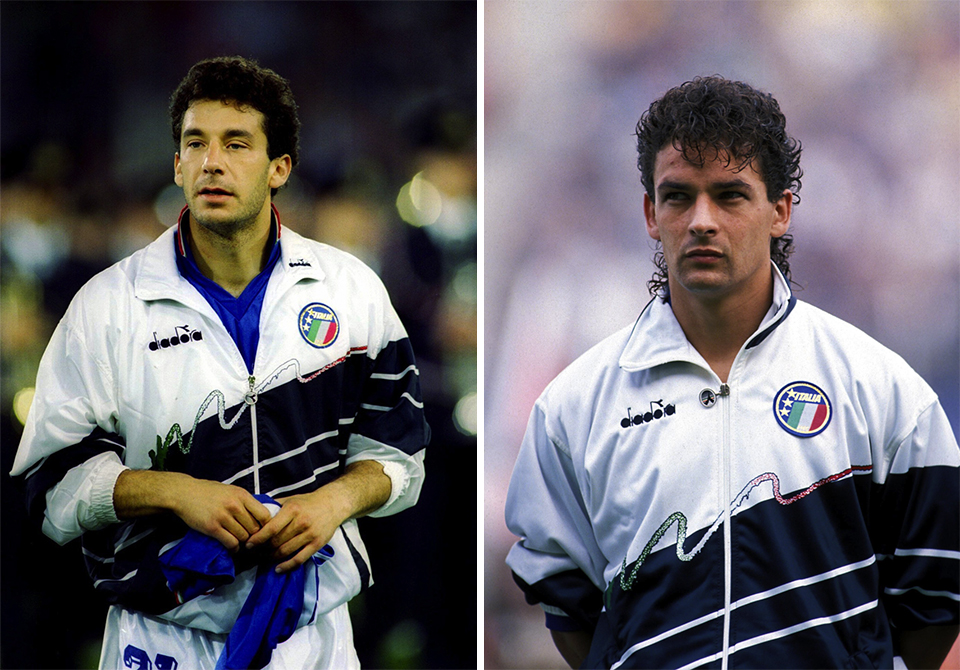
My fixation with Italia ’90 has continued into adulthood. Though the fit had become a little more snug, I wore my 1990 shirt for Italy’s games during the 2006 World Cup. I was living in Florence at the time, and watched the matches from my lucky table number five at Caffé Megara. After the Azzurri‘s victory the bar’s owner said I too deserved a medal for my superstitious devotion. Since moving to New York, thanks to eBay and some online vintage shirt specialists I’ve been able to procure more coveted items from the “Collezione Azzurri 90” range. About three years ago I bought the rarely-seen away shirt, but it was much too big and I sold it to someone in Germany — a decision I now regret. More recently, I’ve landed my hands on both of Italy’s tracksuit tops used during the 1990 tournament. The blue one was used in training while the much rarer white one (which today would be marketed as an “anthem jacket”) was worn by the team as they walked onto the pitch. I’d coveted it for twenty-four years and I still can’t quite believe the search is finally over.
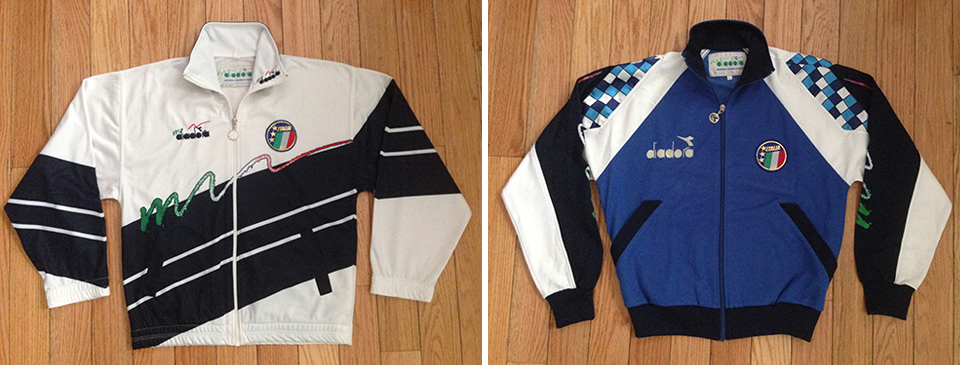
Italia ’90 was the first World Cup I ever followed properly, and perhaps for this reason it remains the most special to me. Though for other reasons it marked a watershed moment in English football culture, it also represents a significant turning point in my life. Today I compare every major tournament to the 1990 World Cup, as if that were the benchmark against which all subsequent competitions must be measured. Even from an organizational and marketing point of view it hasn’t been surpassed. The abstract mascot and logos, the futuristic stadia, the use of a bed of coloured flowers to make up the team flags that displayed during the national anthems — no tournament since has quite been able to top these details. Italia ’90 was the last international tournament not to feature front numbers and names on the backs of players’ shirts, so its clean perfection simply has not been possible since. Maybe this is why Italy’s 1990 kit is still my favourite of all time.